December 2025
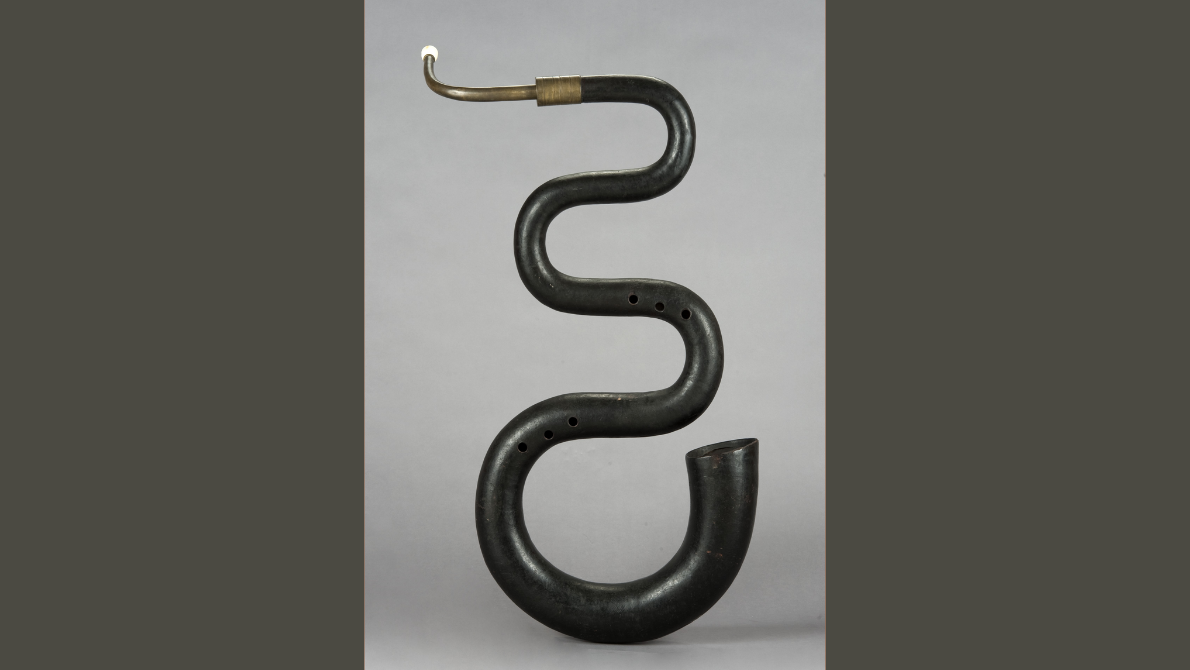
The serpent: a unique wind instrument
The serpent is a wind instrument with a mouthpiece and finger holes. Though made of wood (often bound in leather), it belongs to the brass family because the sound is produced by vibrating the lips in the mouthpiece, as with the trumpet. The name serpent derives from the S-shaped tube of the instrument. The serpent is regarded as the bass of the cornetto family, but its bore is larger, its walls proportionally thinner, and it has no thumb hole. The mouthpiece, usually made of ivory or horn, is attached to the end of a metal bocal. Using its six finger holes, the player can perform all the chromatic notes of the instrument.
Origins and history
The origin of the serpent is unclear, though many musicologists believe it comes from Italy. In any case, the instrument reached its heyday in French churches at the beginning of the seventeenth century, where it accompanied Gregorian plainsong.
In the eighteenth century, the serpent was also used in military bands, and its snake-like shape was made more compact for easier handling. Numerous regional variations existed; at one point, straight versions were even produced. Because these serpents resembled a bassoon, they were sometimes called "Russian bassoons." Keys were eventually added, allowing players to reach finger holes that were otherwise out of reach, opening the way to the ophicleide.
The serpent was played not only in France, but also in Belgium, Germany, and England. In England, in addition to liturgical and military purposes, it was frequently used in theatres.
In the nineteenth century, references to the serpent appear less favorable. Hector Berlioz, who nonetheless employed it in his symphonic works, criticized the instrument sharply: "The essentially barbaric timbre of this instrument would have been far more appropriate to the ceremonies of the bloody cult of the Druids than to those of the Catholic religion." He added: "There is only one exception - the case where the serpent is used in the Masses for the Dead, to reinforce the terrible plainsong of the Dies Irae. Then, no doubt, its cold and abominable howling is appropriate." Clearly, the instrument’s reputation had sharply declined, to the advantage of the ophicleide, which eventually replaced it altogether.
Modern revival and contemporary use
The revival of the serpent, which began in the 1970s, is bearing fruit today. The instrument has made a remarkable comeback in ensembles and orchestras that perform on historical instruments, and it is once again taught at the Paris Conservatoire. Musicians and audiences alike can rediscover all its nuances. Michel Godard uses the serpent successfully in jazz and improvisation, demonstrating that the instrument has far more potential than is often assumed.
Instrument makers are also rediscovering the serpent, producing high-quality examples using traditional methods and sometimes incorporating modern materials such as carbon fibre.
The serpent at the MIM
Among the serpents at the MIM is one attributed to C. Baudouin, who worked in Paris at the beginning of the nineteenth century. It bears the maker's name, which is unusual, as most serpents are anonymous. Another notable example is a keyed serpent, reminiscent of a natural history museum exhibit, built by Ludwig Embach, a German based in Amsterdam.
A visit to the MIM is not complete without seeing the serpent chandelier: ten (originally twelve) serpents are mounted around a Turkish crescent, with their mouthpieces replaced by candles. This inventive method of recycling instruments that had fallen into disuse was devised by the Puurs fanfare wind band.
Text: Géry Dumoulin