September 2026
Fig.1
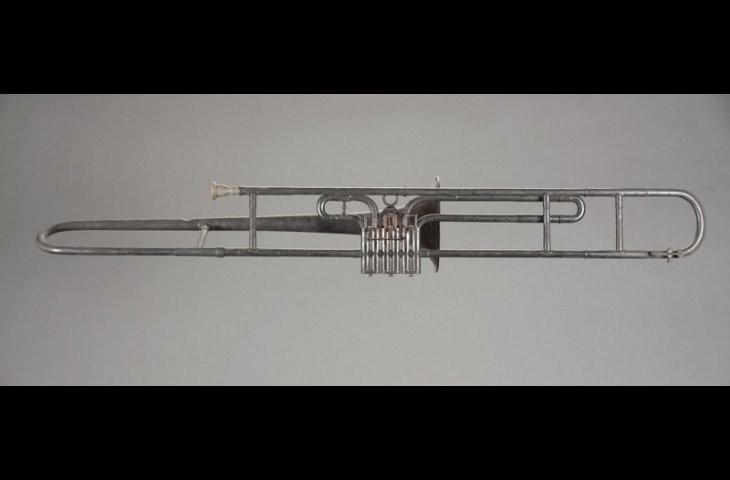
Valved trombone, D. and P. Lebrun, Brussels, 1903-1950, inv. 3880
Fig.2
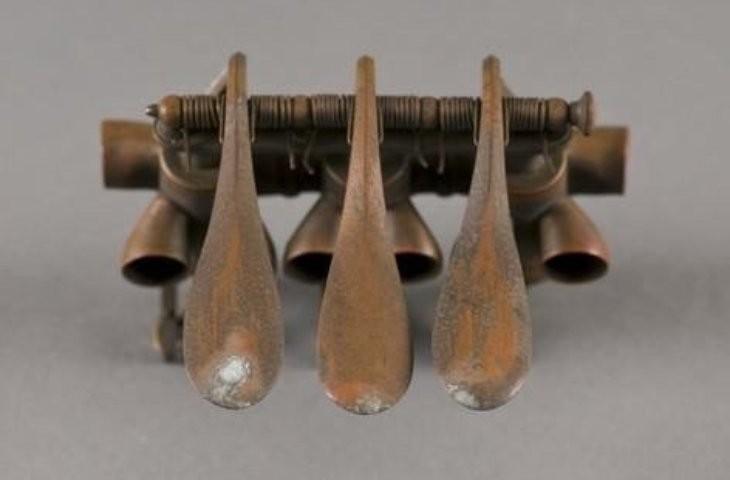
Valves, David Hall, Boston, vers 1861, inv.3885
Fig.3
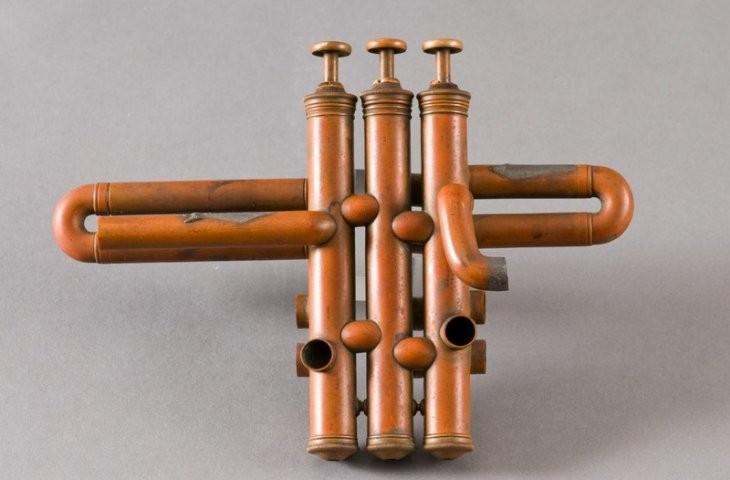
Valves, Besson, Paris, 1851/1900, inv.3881
Fig.4
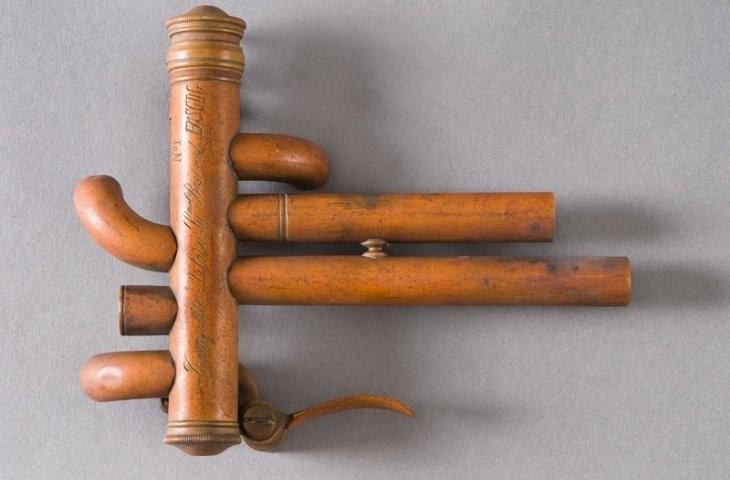
Valves, Louis Bouvet, Paris, vers 1885
Fig.5
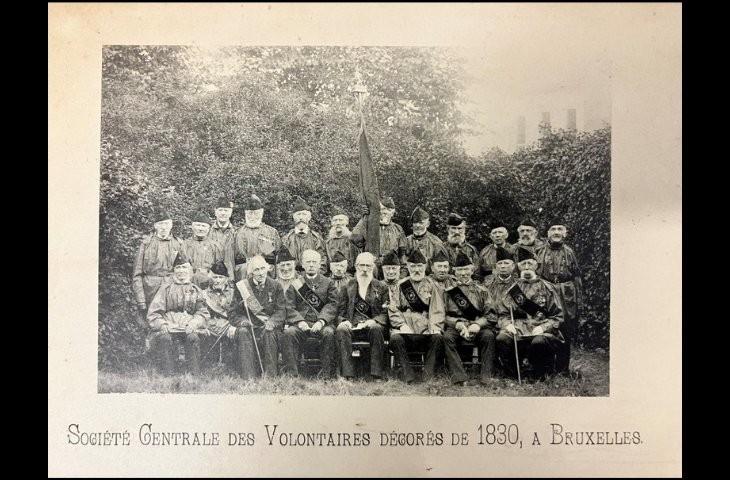
Société Centrale des Volontaires décorés de 1830, Brussels, MIMICO.V.48, © E. Castelein
Fig.6
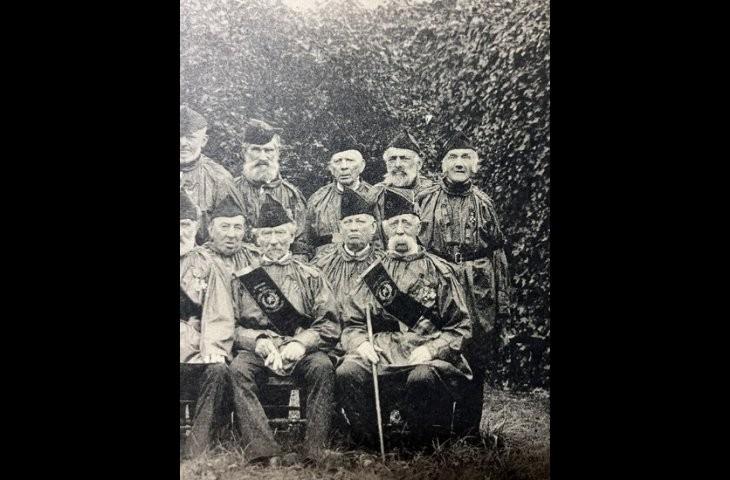
Société Centrale des Volontaires décorés de 1830 (détail), Brussels, MIMICO.V.48, ©E. Castelein
Fig.7a
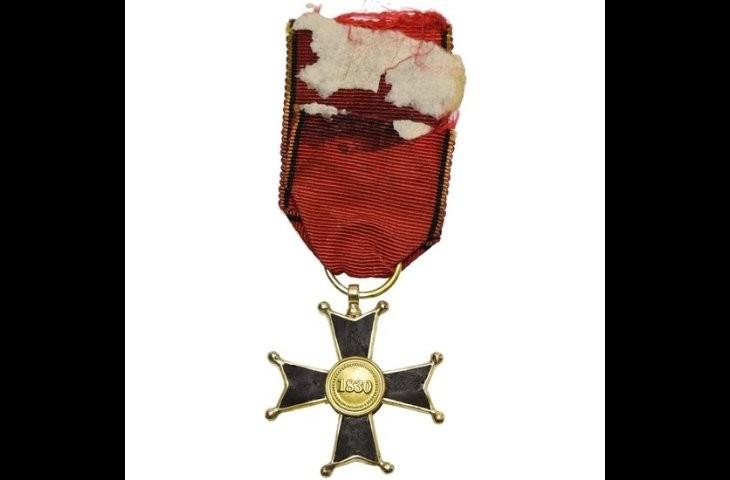
Iron Cross, 1830 (awarded in 1833), ©Jean Helsen & Fils
Fig.7b
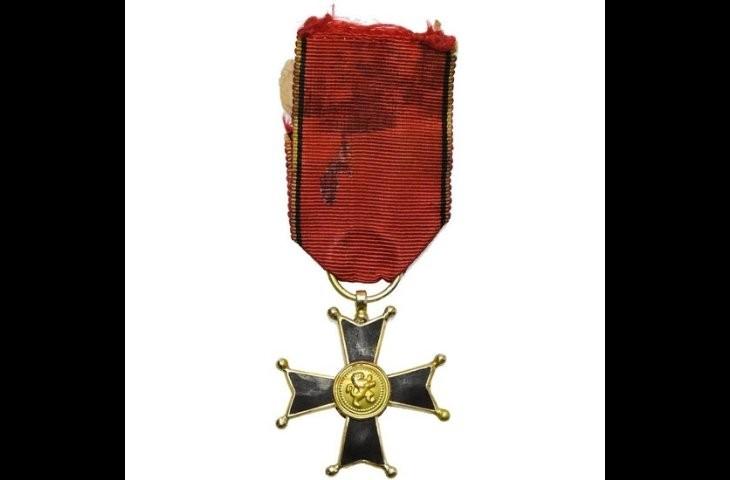
Iron Cross, 1830 (awarded in 1833), ©Jean Helsen & Fils
Fig.8
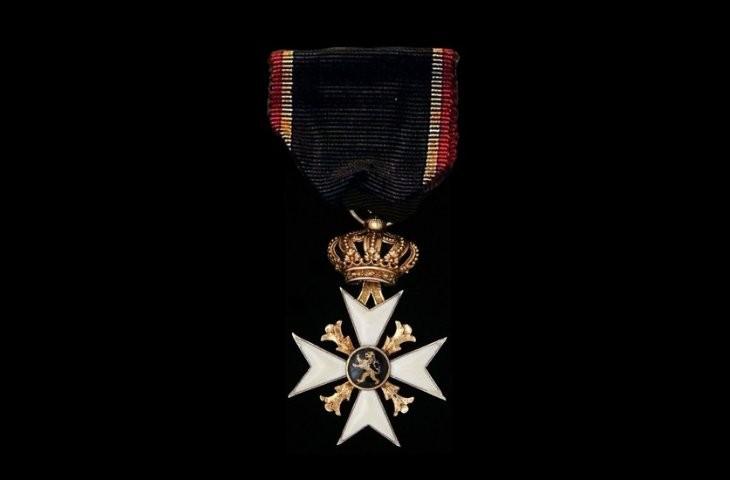
Commemorative cross of the 1830 volunteers, © Madelgarius
A donation revealing a family history
In 1962, Michel Lebrun, a descendant of the brass instrument maker Henri Lebrun, donated to the museum a three-valve Shaw-system trombone (inv. 3880, fig.1), as well as various valve systems (inv. 3881, 3882, 3883, 3884, 3885, 3886, figs.2 to 4) that had belonged to the family workshop. He accompanied this donation with a rare and somewhat moving historical photograph (fig.5). It depicts the volunteers who took part in the fighting in September 1830, which led to the proclamation of Belgian independence. The photograph was taken on 23 September 1894, 64 years after the events. Henri Lebrun, the donor’s ancestor, is standing on the far right, recognisable by his long moustache (fig.6). The donation of this photograph holds particular significance due to the links between the museum and the Lebrun factory, as we shall see below.
Henri Lebrun was born in 1814. At the age of 19, he began as an apprentice, and later as an employee, at the workshop of Charles-Joseph Sax, father of the inventor of the saxophone. He continued his career in Paris but returned to Brussels as early as 1846. He then founded a factory specialising in the production of valves and cylinders for brass instruments. The craft of valve-making requires advanced technical knowledge, both in the working of metals and in manufacturing techniques such as hammering, annealing and brazing. He also designed or adapted cylinder and valve systems to suit the specific requirements of each instrument, ensuring smooth and precise operation. Finally, these components must form a perfect seal to prevent air from escaping through the mechanism.
In the 19th century, renowned workshops, such as the Mahillon firm, entrusted the role of chief valve-maker to undisputed masters of mechanics. These specialists were often behind patents or technical improvements that revolutionised the precision and accuracy of the instruments. In this instance, it was Henri Lebrun to whom the Mahillon firm, founded by Charles Borromée Mahillon, entrusted this important post. His son, Victor-Charles, succeeded him and also became the first curator of the musical instrument museum.
In 1870, the Lebrun firm expanded its activities to include the manufacture of complete instruments. Three years later, Henri was granted a patent for a method of manufacturing valve casings.
But the company’s history does not end there. It was taken over by his son, Michel (1836–1903), who also joined the Mahillon factory, where he held the same position as his father. In this capacity, he was awarded a gold medal at the 1889 Paris World’s Fair. At that time, the firm C. Mahillon & Co enjoyed an international reputation and distinguished itself by winning numerous awards at world exhibitions.
In the early 20th century, Désiré and Pierre, Henri Lebrun’s grandsons, took over the management of the factory and specialised in the manufacture of six- and seven-valve trombones. They were awarded a gold medal at the 1910 Brussels World’s Fair for a seven-valve trombone based on the Eugène Detiège system, an example of which was acquired by the museum in 1925 (inv. 3861).
The Lebrun firm remained in business until after the Second World War. The 1962 donation is therefore, following the firm’s closure, a memento of its links with the museum’s first curator.
A photograph that raises questions
This photograph complements the donation and sheds light on an aspect of Henri Lebrun’s personal history. It was taken during the commemorations of the Four Days of Brussels, which led to Belgium’s independence. In the picture, 38 volunteers are seen wearing the revolutionary uniform: a white shirt and trousers, a blue smock, a black scarf and a police cap adorned with a tricolour cockade.
Henri Lebrun, aged 80 at the time the photograph was taken, was just 16 in 1830. His uniform bears two decorations. Firstly, the Iron Cross (with four notched arms, figs.7a and b), established in 1833 to reward citizens who had been wounded or had shown outstanding bravery, or who had rendered remarkable services. Secondly, the Commemorative Cross of 1830 (with four notched arms in white enamel, adorned with a gold Cross of Burgundy, fig. 8), established in 1878.
However, we have been unable to determine the exact nature of Henri Lebrun’s involvement or the role he played during the Revolution. Indeed, his name does not appear in the official lists of recipients of either the Iron Cross or the Commemorative Cross.
Nevertheless, this does not mean that he did not play an active role, despite his young age. In any case, the donation from his great-grandson has made it possible to put a face to this figure from the Belgian Revolution – a Brussels instrument maker who worked alongside the greatest masters of his time.
Text: Anne-Françoise Theys
Bibliography
- Haine, Malou, et Nicolas Meeùs. Dictionnaire des facteurs d’instruments de musique. Liège, 1986.
- Larigot, no. VIII, numéro spécial : « Essai de classification alphabétique des facteurs, ouvriers, inventeurs, marchands… belges d’instruments de musique à vent ». Braine-l’Alleud, 1998.
- Liste nominative des citoyens décorés de la Croix de fer, publiée d’après le Moniteur, par les soins du Comité de la Société centrale des décorés de la Croix de fer. Bruxelles, 1865.
- Pasinomie ou collection complète des lois, décrets, arrêtés et règlemens généraux qui peuvent être invoqués en Belgique. Troisième série. Bruxelles, 1834.
- Simon, Victor. Les Combattants de 1830 : ce que la Patrie belge a fait pour eux. Bruxelles, 1930.
- Thibouville-Lamy, M. J. Rapport du jury international, Exposition universelle internationale de 1889 à Paris. Paris, 1891.
- Waterhouse, William. The New Langwill Index: A Dictionary of Musical Wind-Instrument Makers and Inventors. London, 1993.
- « 1830 ». 1830.be. [On line]. www.1830.be.