October 2026
Fig.1
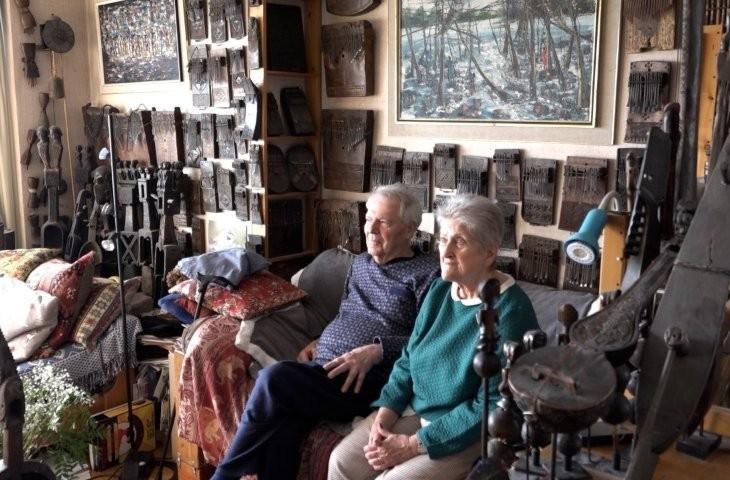
François and Françoise Boulanger-Bouhière with part of the collection in their living room, Brussels, 2021
Fig.2
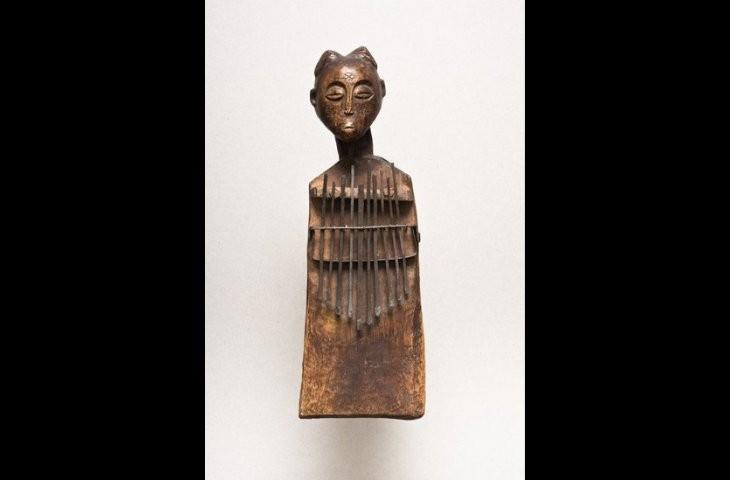
Libungu, DRC, artist of unknown cultural background, undated, inv. D2021.002.130
Fig.3
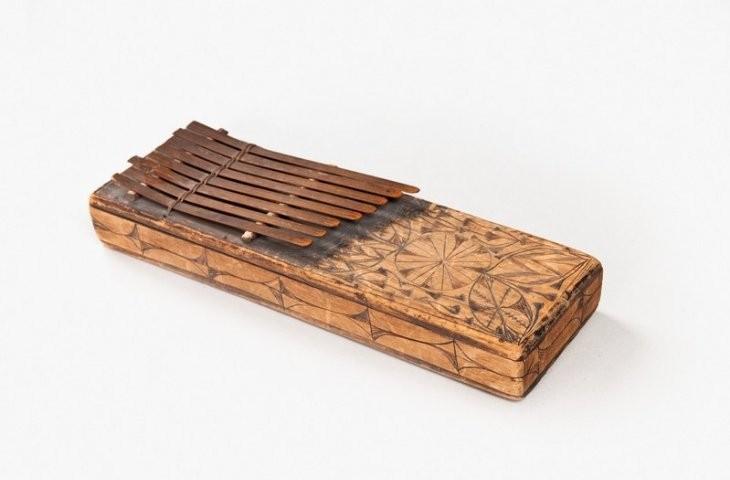
Sanza, Nigeria, unknown Igbo maker, undated, inv. D2021.002.271
Fig.4
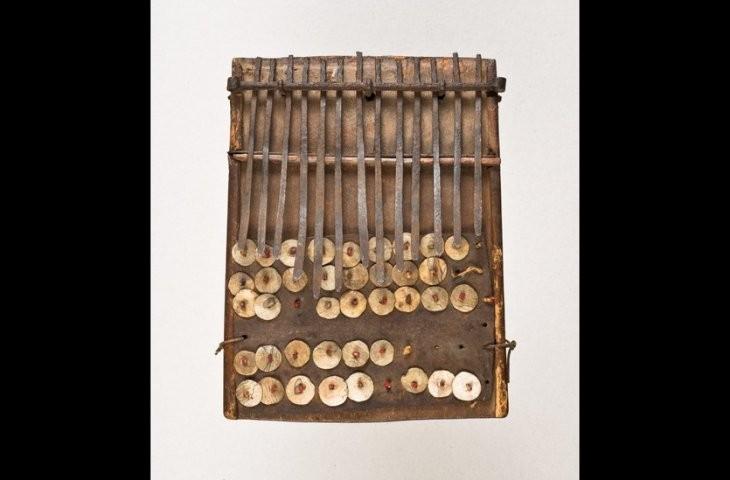
Mbira matepe, Lower Zambezi region, unknown Shona maker, undated, inv. D2021.002.005
Fig.5
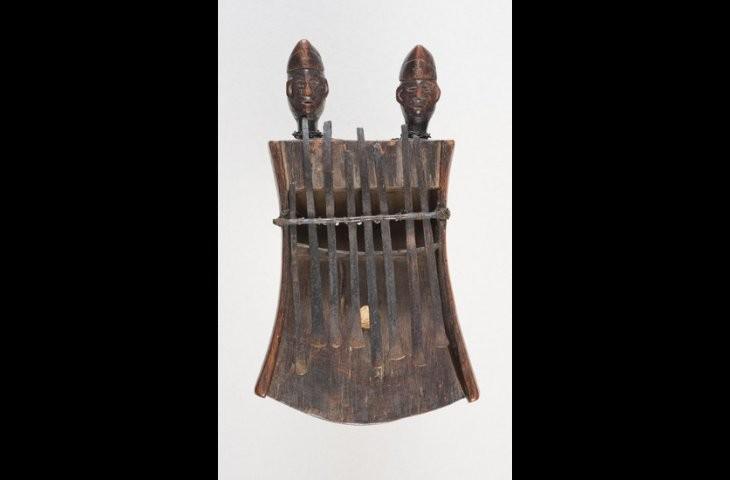
Kankobele, DRC, unknown Tabwa maker, undated, inv. D2021.002.033
Fig.6
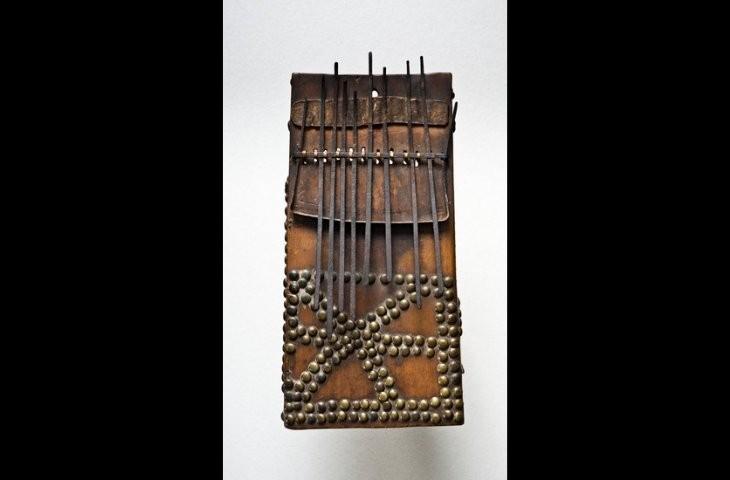
Likembe, DRC, maker of unknown cultural background, undated, inv. D2021.002.113
Fig.7
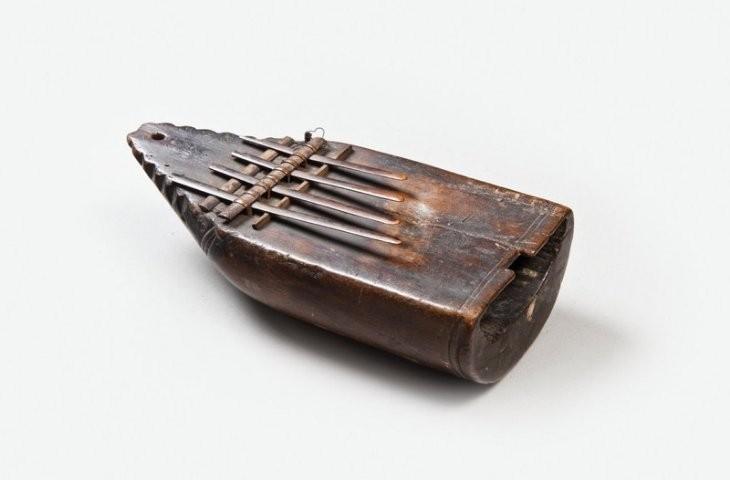
Tsimbi, Maritime Region of Lower Congo, undated, inv. D2021.002.009
Fig.8
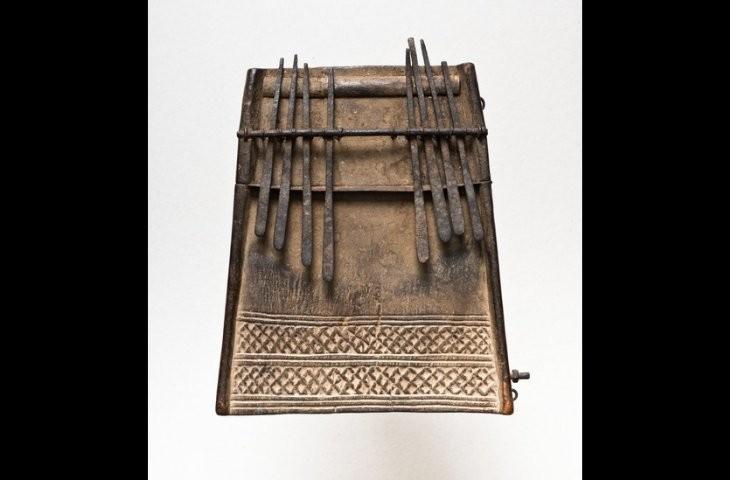
Kinsaanji mucapata, unknown Tchokwe artist, undated, inv. 2021.002.299
A unique collection at the heart of African musical traditions
The Boulanger-Bouhière collection (fig.1) comprises some 600 sanzas. It is an international benchmark for African instruments and represents the many types of sanzas native to sub-Saharan Africa.
After living in the Congo for several years in the late 1960s, engineer François Boulanger and his wife, Françoise Bouhière, began collecting sanzas. This small lamellophone had by then all but disappeared from everyday African musical life. Over the course of 50 years, the couple assembled a unique collection that bears witness to a fascinating tradition.
The collection is remarkable not only for its diversity but also for the quality of its instruments. François Boulanger also took great care to document his collection. Each instrument was described in minute detail in various publications (geographical origin, organological description, typology, provenance, etc.) and in an online inventory (which has since been lost). However, thanks to the support of the King Baudouin Foundation, half of the collection is now held at the MIM in Brussels, whilst the other half is in Paris. It offers an overview of musical traditions of significance to the African continent. It also reflects the shared history between Africa and Europe.
African sanzas
Sanzas are lamellophones (fig.2). Sub-Saharan Africa is home to many different types of sanzas. Lamellophones originate from two distinct regions: the savannahs of Cameroon and the Lower Zambezi region. They subsequently spread across the entire sub-Saharan continent and come in a wide variety of shapes and sizes. The slave trade also led to the introduction of the instrument into several regions of South America (Brazil, Haiti, Cuba, Puerto Rico, Jamaica), where its use remains very much alive today.
Sanzas are handcrafted, made entirely by hand. The musician holds the instrument in both hands and plucks the reeds with both thumbs. Each reed produces a single note. The reeds are arranged according to the scales used in the region where the instrument is played. Sanzas are always fitted with additional elements: pieces of metal, glass, shells, wood and stones. As they vibrate, these elements enrich the sound produced by the reeds. These simple instruments produce music that can relax, make people dance, call for rain or communicate with the ancestors.
From the 17th century onwards, European travellers encountered an instrument that was unknown to them. Depending on the era, they referred to it as the ‘thumb harp’, ‘fingernail violin’, ‘thumb piano’, ‘hand piano’ or even ‘pianino’. David Livingstone mentions a ‘sanza’ in his writings, and this name became a generic term for all instruments in this family. Later, the more scientific term ‘lamellophone’ became established amongst researchers.
The Boulanger-Bouhière collection includes many different types of sanzas. Some bear witness to European influence (recycled materials such as bottle caps, umbrella ribs, etc.). Here are a few examples.
Raffia type, Niger Delta (fig.3)
These lamellophones have tongues made from raffia or bamboo stalks, plants commonly found in this region. Small balls of wax are applied to the tongues to tune the instrument.
Mbira (fig.4)
These lamellophones are undoubtedly the oldest to feature metal tongues. They originate from the Lower Zambezi region. The mbira’s timbre is rich in harmonics and enhanced by rattling elements. The musician plays short melodies, which are repeated with slight variations. The sound of the mbira possesses a powerful emotional force, which plunges the musician and the audience into a trance-like state. The instrument then becomes the voice of the ancestors.
Tabwa (fig.5)
The Tabwa lamellophones, originating from eastern Congo, have eight metal strips arranged in two ‘keyboards’, ascending and descending. The two heads adorning the top of the instrument inspire the musician. These decorative elements have made these instruments highly sought-after by collectors.
Likembe (fig.6)
The likembe first appeared in southern Congo at the end of the 19th century, against the backdrop of colonisation. At that time, it was used to accompany long marches or days’ work. Inside the soundbox are small pebbles, dried beans and pieces of glass. When the musician shakes the instrument, these rattles give it its characteristic timbre. Today, the traditional likembe has all but disappeared, but an amplified version is gradually gaining in popularity.
Loango (fig.7)
Loango is a small village situated north of Pointe-Noire, in Congo-Brazzaville. From the 16th century onwards, the port of Loango was a hub for the slave trade. This dark period influenced the shape of the local lamellophones, which resemble boats.
Kisani and mucapata (fig.8)
These two instruments of the Chokwe people of Angola developed through contact with the mbira. They were used to provide musical support for porters and scouts during long expeditions from Angola to Mozambique. The kisani is often adorned with beautiful geometric patterns. The mucapata has become rare. It resembles the instrument described by Livingstone during his expeditions.
Text: Saskia Willaert
François Boulanger & Françoise Bouhière sanza’s collection
Bibliography/webography
- Boulanger's blog: and François Boulanger's sanza collection on Pinterest, with extensive information on the provenance of the instruments
- Gerhard Kubik, Kalimba-Nsansi-Mbira. Lamellophone in Afrika, Berlin: Museum für Völkerkunde, 1998
- Saskia Willaert, unpublished guide to the exhibition Tuned Raindrops, MIM Brussels, September–December 2005
- Françoise Barrier, François Boulanger. Chronicle of a Sanza Collector, Tribal Art Magazine, 2011, pp. 120–121
- ‘Sanza’. Exposition des lamellophones de la collection F. & F. Boulanger-Bouhière, exhibition catalogue, Bruneaf, Brussels, 8–12 June 2011
- Sanza: African Thumb Pianos from the Collections of F. & F. Boulanger-Bouhiere, Royal Museum for Central Africa and MIM, exhibition catalogue, MIM, Phoenix, Arizona, 2012