July 2026
Fig.1
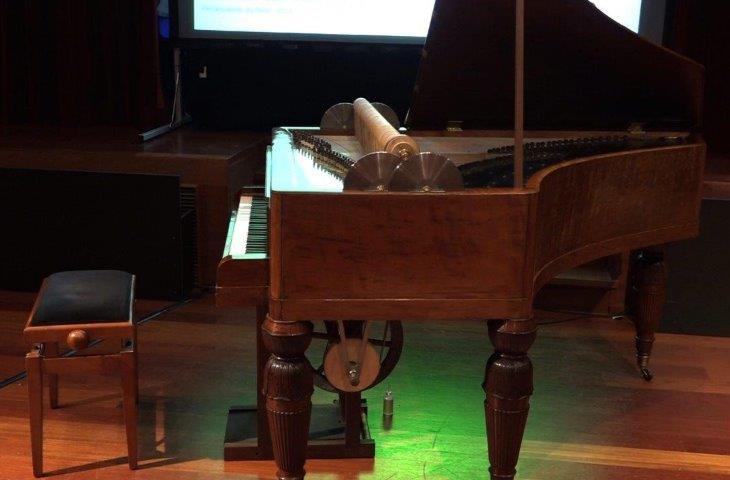
Piano-viole, Lichtenthal, Brussels, around 1835, inv. D2014.001.002
Fig.2
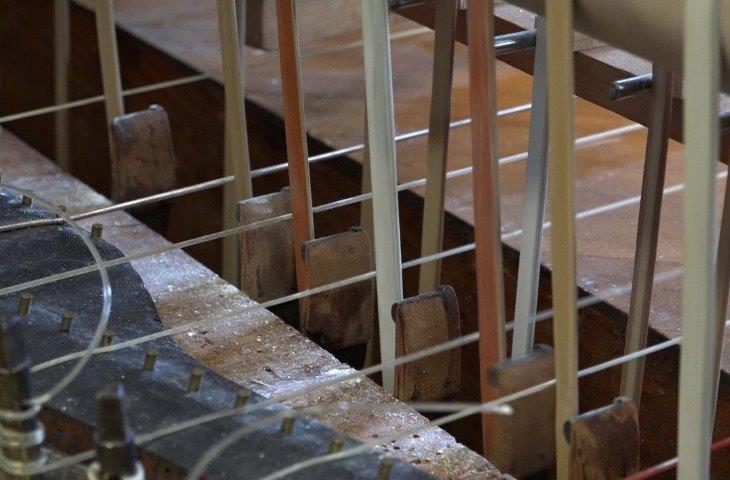
Leather bows, piano-viole, inv. D2014.001.002
Fig.3
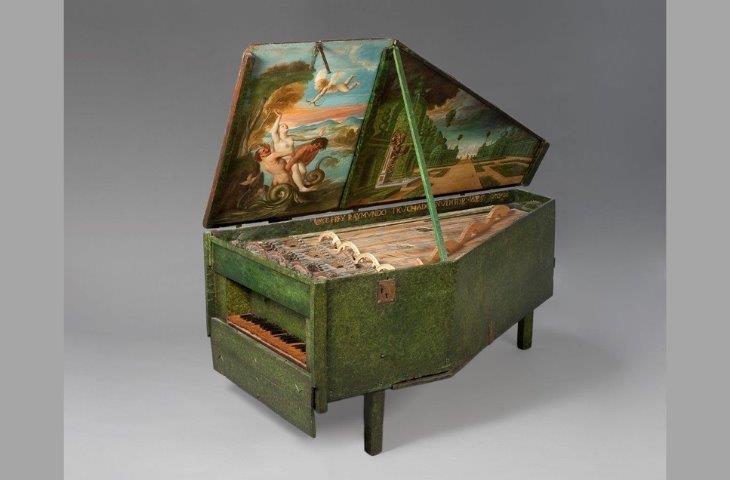
Geigenwerk, Fray Raymundo Truchado, 1625, Inv. 2485
Fig.4
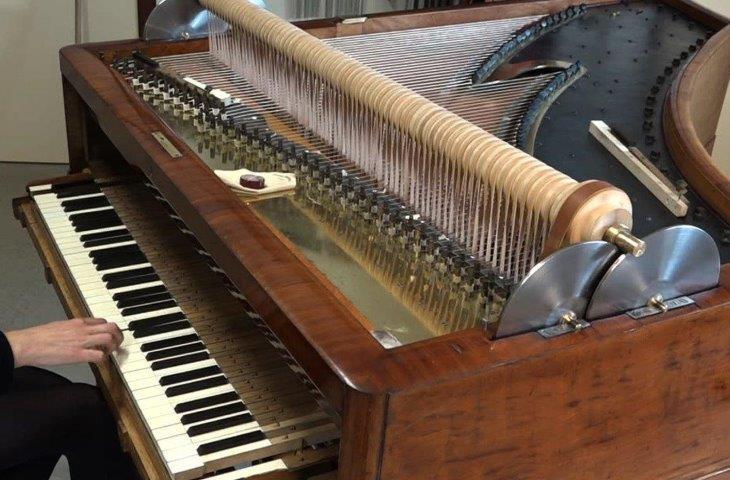
Restored piano-viole, Lichtenthal, Brussels, around 1835, inv. D2014.001.002
Fig.5
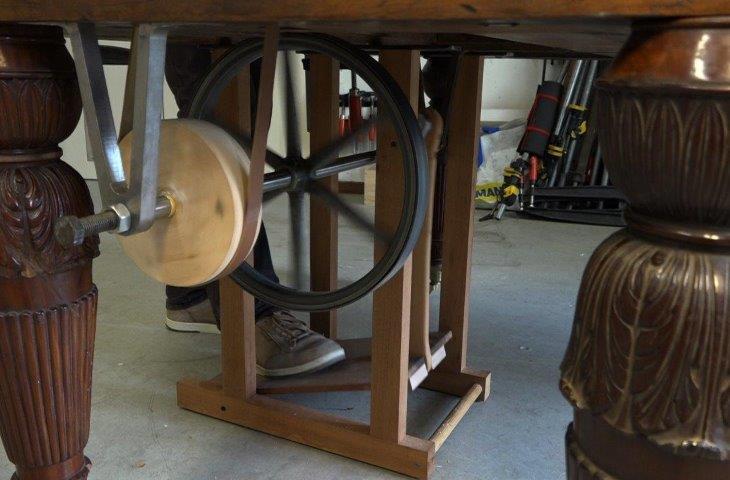
Pedal operating the bows, piano-viole, inv. D2014.001.002
Fig.6
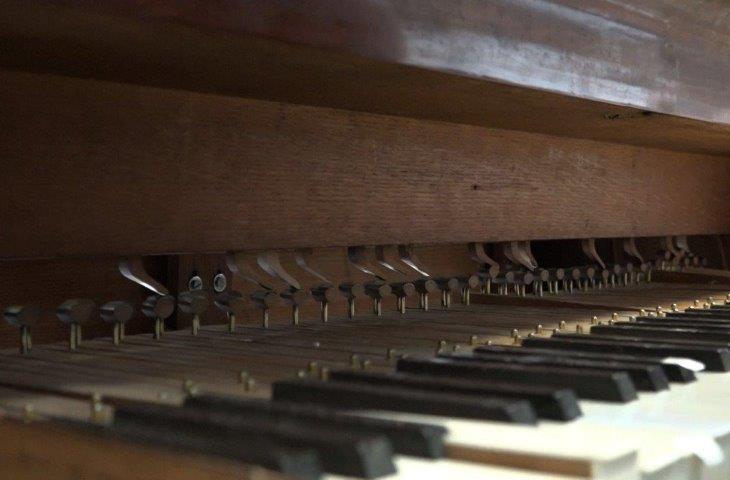
Keyboard mechanism, piano-viole, inv. D2014.001.002
From Leonardo da Vinci's concept to Herman Lichtenthal's prototype
The invention of the piano-viole (fig. 1) is attributed to Leonardo da Vinci, who left three sketches of a « viola organista » in his notebooks of 1493–1495. In the following centuries, several instrument makers tried to build an instrument in which the keys, instead of being struck (piano) or plucked (harpsichord), were played with a bow (fig. 2). Few succeeded, and only a few rare examples have been preserved worldwide. The oldest known instrument, built in 1625 by the Spanish monk Raymundo Truchado, is on display at the MIM in the “Western Classical Music” room (fig. 3).
At the beginning of the 1830s, one of the most talented Brussels piano builders, Herman Lichtenthal (Silesia/Poland? 1795 – Saint Petersburg 1853), also tried his hand at this adventure. In 1835, he displayed a prototype at the first Exposition nationale du Royaume de Belgique in Brussels. Visitors were thrilled, the press was enthusiastic, and Lichtenthal obtained a gold medal, the highest honour. King Leopold I, who visited the exhibition, was also won over and purchased a model. The instrument worked for a while, but then the mechanism jammed. Lichtenthal had meanwhile moved to Saint Petersburg and could not immediately repair the instrument. The piano-viole was therefore moved to the palace attics.
The rediscovery and restoration of the piano-viole
One hundred and fifty years later, the MIM was contacted by the curator of the royal collections, who had discovered several instruments that appeared interesting, including the piano-viole. Deposited at the MIM, it underwent a patient and delicate restoration lasting almost two years. A large number of the parts of the mechanism had been lost or destroyed over the years, while the patents filed by Lichtenthal were missing. A copy of one of the patents was eventually found in a New York library. On this basis, with the assistance of the school of musical instrument making attached to Ghent University (Hogeschool Gent), the engineering faculty of UCL, the Delvaux company, and various instrument makers, Pierre Gevaert, keyboard instrument restorer at the MIM, was able to bring the piano-viole back to life (figs. 4, 5 and 6). Thus, music lovers today can enjoy its hybrid sound, which lies midway between that of the organ and the viola da gamba (videos).
Text: Pascale Vandervellen