February 2026
Fig.1
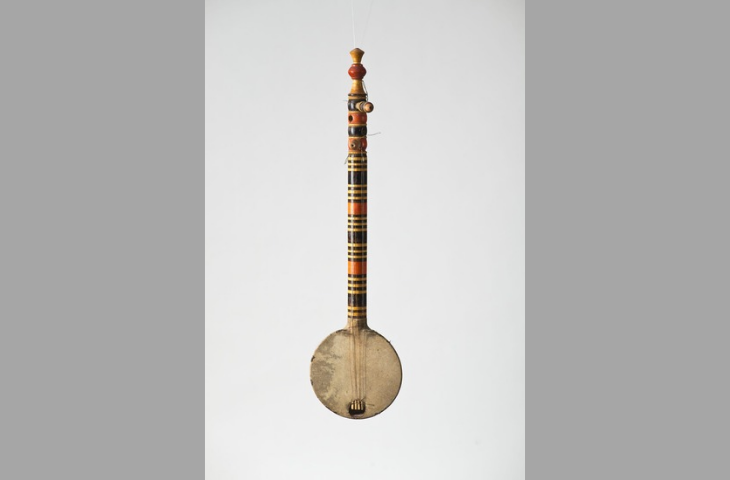
Lotar (plucked lute), Morocco, ca. 1970, inv. 2020.0004
Fig.2
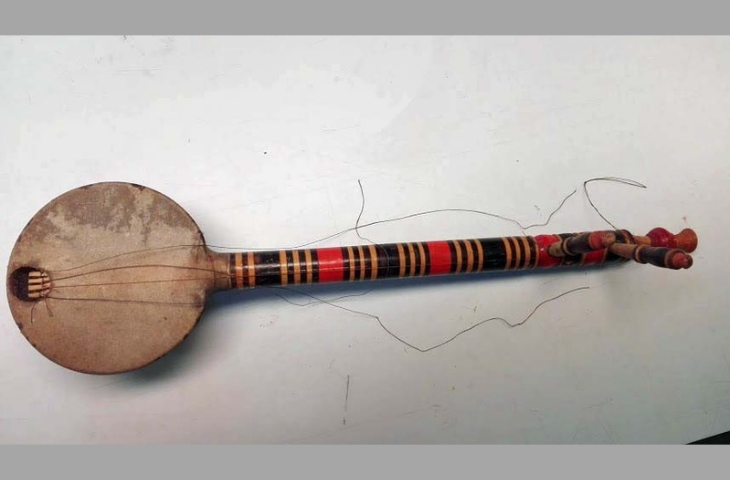
Lotar (plucked lute), Morocco, ca. 1970, inv. 2020.0004
Fig.3
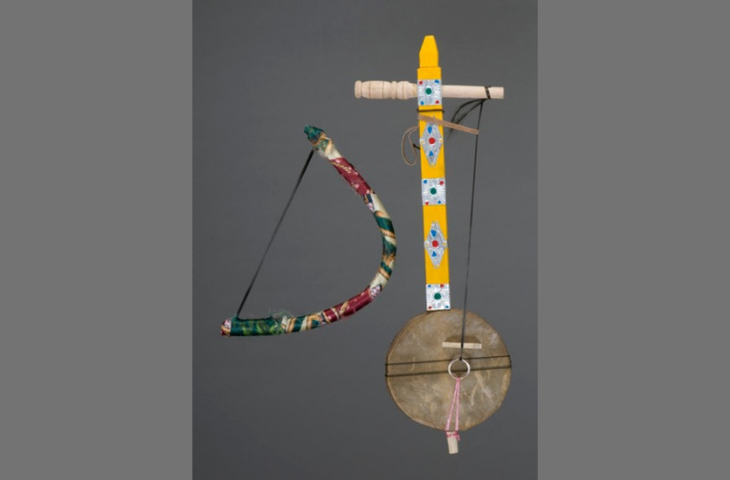
Soussi rebab, Morocco, 20th century, inv. 2009.026
The lotar: a Berber lute
The only circumstantial information accompanying this anonymous lute when it entered the MIM in the spring of 2020 was that it had been bought by Jean-Pierre Bauwens (father-in-law of Pierre Gevaert, one of the MIM’s conservators), possibly in Morocco, probably in the 1970s.
The instrument (fig. 1) has a long, round neck, painted in bright colours, ending in four pins emerging at the sound hole (a so-called “tanged lute”). Each of the remaining four strings is attached to one of these pins. The other ends are fitted to tuning pegs, two of which are missing. The strings are made of vegetable material. The sound box consists of an earthen bowl covered with goatskin. The loose bridge is missing.
All these characteristics clearly point to the lotar, a folk lute of the Berbers from the High Atlas Mountains in Morocco. Such lutes have a distinctive design: four or five strings run over a solid, decorated neck that ends in the sound hole. Their sound boxes are usually made of recycled materials, such as earthen bowls or metal boxes, covered with goatskin.
Playing style and the Rwais tradition
Lotars are played with a long plectrum. They produce a characteristic staccato sound and are often combined with the more fluid tone of the soussi rebab, a colourful Berber fiddle (a fine example of which is displayed in the “African Fiddles” showcase at the MIM).
The Rwais (singular: Rais) are professional itinerant musicians belonging to the Ishlhin Berber mountain group. They perform in small ensembles ranging from two to a dozen musicians. Their music is not influenced by Arabic traditions but has grown out of indigenous Berber culture. A Rwais performance includes instrumental music, singing, dance and comedy.
The lotar and the soussi rebab play lively melodies, often in unison. As one Rais put it: “Our melodies are like the road over Tizi-n-Test (a mountain pass in the High Atlas): lots of sharp bends and steep slopes” (recorded by the American ethnomusicologist Philip Schuyler in the 1970s). Binary and ternary rhythms are clapped by hand or played on drums, metal bowls or bells, either simultaneously or successively, thus creating a rhythmic tension that gives Berber music its distinctive vitality (Schuyler 1979). Responsorial singing (call and response) is the dominant vocal form.
As professionals, the Rwais travel in search of a paying audience. Their pre-composed or (semi-)improvised songs are not mere entertainment: they reflect on human nature and life in general, recount personal travel experiences, comment on political, economic or moral issues, praise important or wealthy members of the community, and often voice sharp social criticism.
Tradition and modern adaptations
The lotar may be replaced by the more modern banjo, which produces a similar staccato sound. Ensembles also sometimes combine lotars and banjos, or replace the soussi ribab with a guitar. These adaptations illustrate how the lotar remains embedded in a long yet still vibrant Rwais musical tradition, continually evolving while retaining its distinctive character.
Text: Saskia Willaert
Bibliography
- Lothart-Jacob, B. “Berber music.” In The New Grove Dictionary of Music and Musicians. Ed. Stanley Sadie. London, 1984. Vol. 2, p. 517-19.
- Schuyler, Philip D. “Rwais and Ahwash: Opposing Tendencies in Moroccan Berber Music and Society.” The World of Music 21, no. 1 (1979): 65–80
- Schuyler, Philip D. "Morocco, Kingdom of." Grove Music Online. 2001; Accessed 26 Nov. 2021
- http://uworldmusichouse.blogspot.com/2013/04/day-17-morocco-lotar.html