May 2026
Fig.1
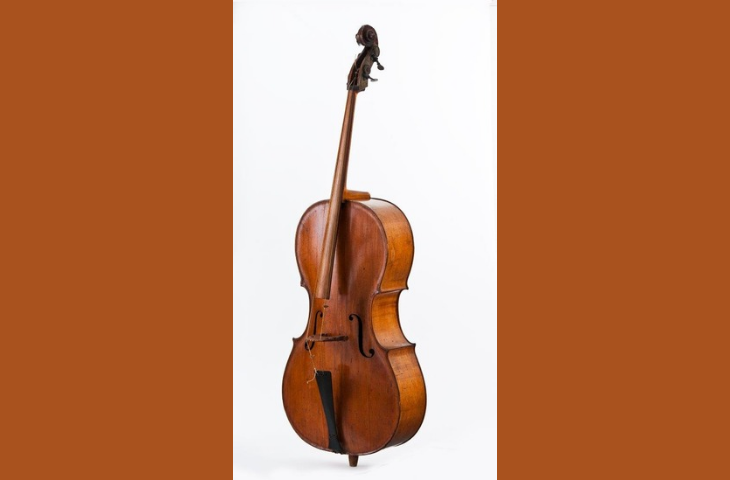
Double bass, Benoît-Joseph Boussu, D2014.324
Fig.2
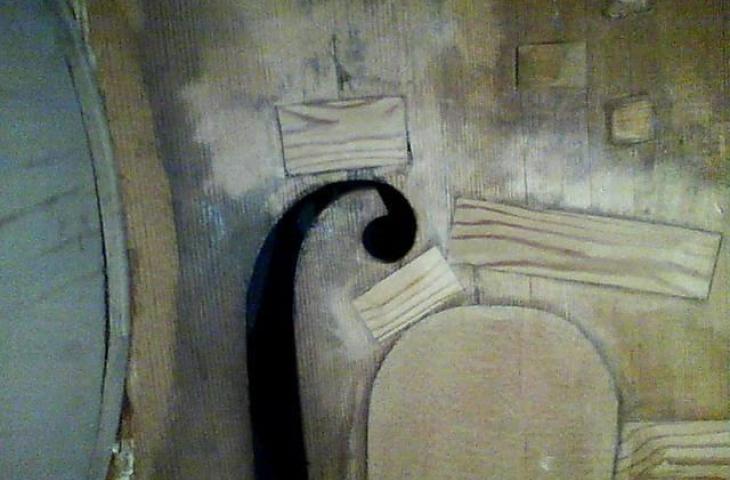
Double bass (inside view), Benoît-Joseph Boussu, D2014.324
Fig.3
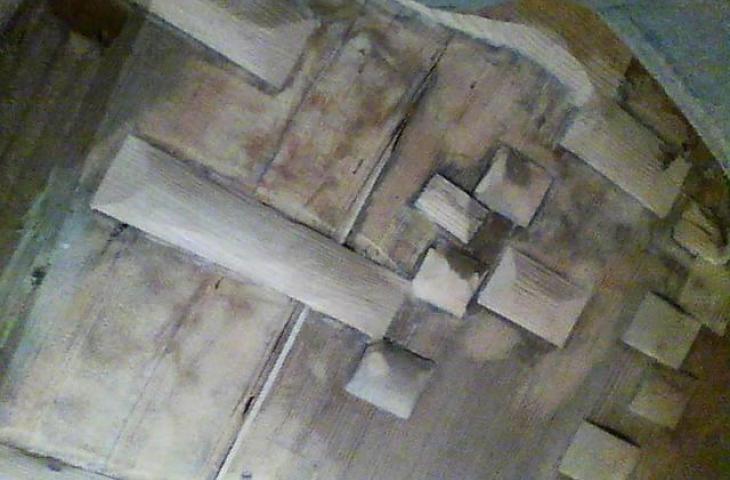
Double bass (inside view), Benoît-Joseph Boussu, D2014.324
Benoît Joseph Boussu: A rediscovered master luthier of the Austrian Netherlands
The figure of Benoît Joseph Boussu has remained obscure for many years, despite the fact that his instruments are among the most remarkable produced in the Austrian Netherlands in the 18th century. Thanks to recent research by Geerten Verberkmoes, the origins and career of this atypical luthier are now well documented.
Boussu was born in Fourmies (northern France, a few kilometres from the present-day Belgian border) in 1703. He began his professional life as a notary, then in the middle of the 18th century launched his career as a luthier, first in Liège and then in Brussels. Between 1761 and 1771, he possibly lived in the Netherlands for a shorter or longer period, in Leiden or Amsterdam. He died in his region of birth in 1773.
The bowed string instruments made by Boussu are situated in the tradition of the Old Netherlands, where the neck and upper block are carved in one piece, in which the upper rib parts are locked.
18th-century sources tell us that Boussu's instruments were highly regarded in the Brussels musical milieu. For example, we know that the dancing master and publisher Joseph-Claude Rousselet owned a “Bossu bass”. The collegiate church of St. Michael and St. Gudula also possessed a Boussu violin, cello, and contrabass, among other instruments given to the church by Canon Vanden Boom.
The MIM's double bass and its value for the collection
The contrabass bought by the Léon Courtin – Marcelle Bouché Fund (managed by the King Baudouin Foundation) dates from the end of Boussu’s period of activity in Brussels, as its label, dated 1760, confirms.
The instrument is near enough in its original condition. However, the neck has been replaced, probably at the beginning of the 19th century, which was the case for most instruments constructed during the Ancien Régime that remained in use after 1800. The scroll, on the other hand, is certainly original. As with other Boussu instruments, its deeply carved volute makes an additional half-turn, as distinct from “classic” scrolls.
Visible damage to the contrabass’s scroll is characteristic of instruments that underwent frequent movement. Evidence of this phenomenon can also be seen on instruments from the Royal Chapel in Brussels that were frequently transported to different churches.
One striking alteration to the Boussu contrabass concerns the strings. Originally there would have been three. In the course of the 19th century, this number was increased to four, but the nut and tailpiece were not replaced. This transformation explains the presence of five holes in the tailpiece and seven grooves on the nut, the aim of which was obviously to create better spacing for the strings.
The Boussu contrabass has also undergone several repairs, in particular to the soundboard.
For the Musical Instruments Museum, the Boussu contrabass constitutes an important acquisition for several reasons. As the work of a luthier who made some of the finest bowed string instruments in our region in the 18th century, it completes the museum’s collection of violins and cellos made by his hand.