Épinette des Vosges
November 2026
Fig.1
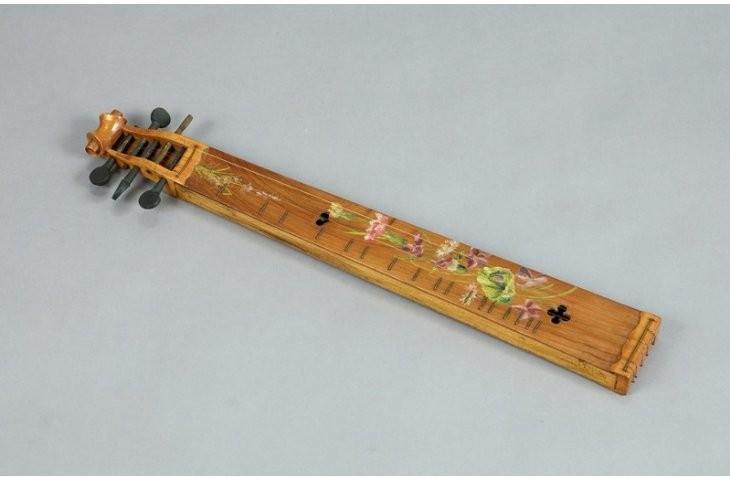
Epinette, A. Lambert–A. Balandier, Val d’Ajol, 1885/1895, inv. 3313
Fig.2
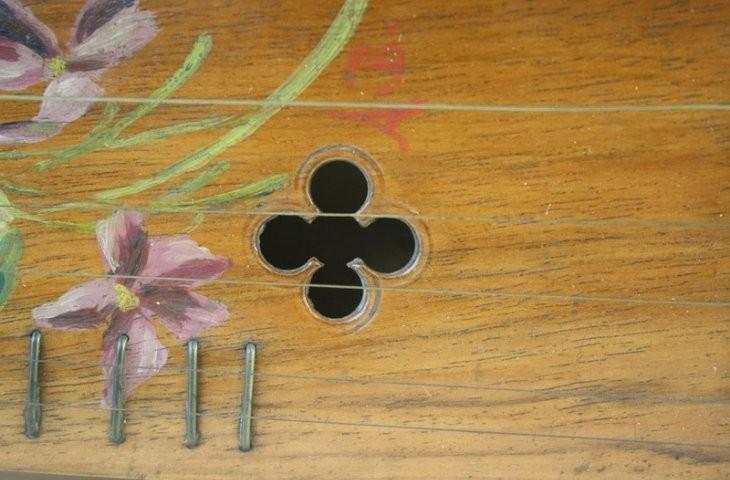
Epinette (detail), A. Lambert and A. Balandier, Val d’Ajol, 1885/1895, details, inv. 3313
Fig.3
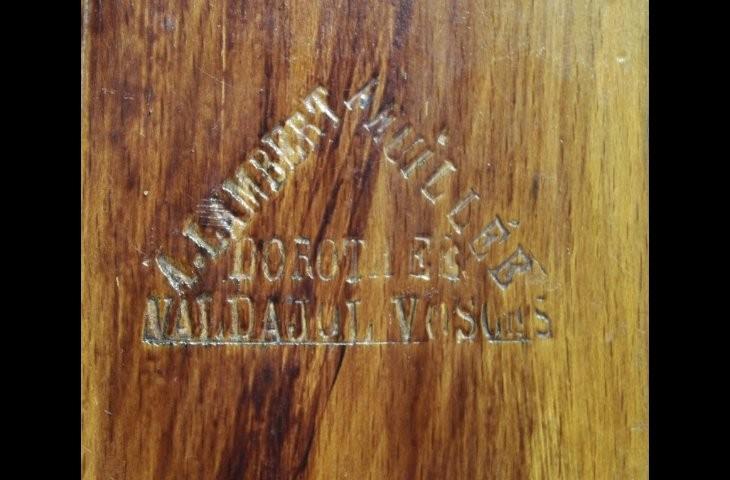
Epinette (detail), A. Lambert and A. Balandier, Val d’Ajol, 1885/1895, details, inv. 3313
Fig.4
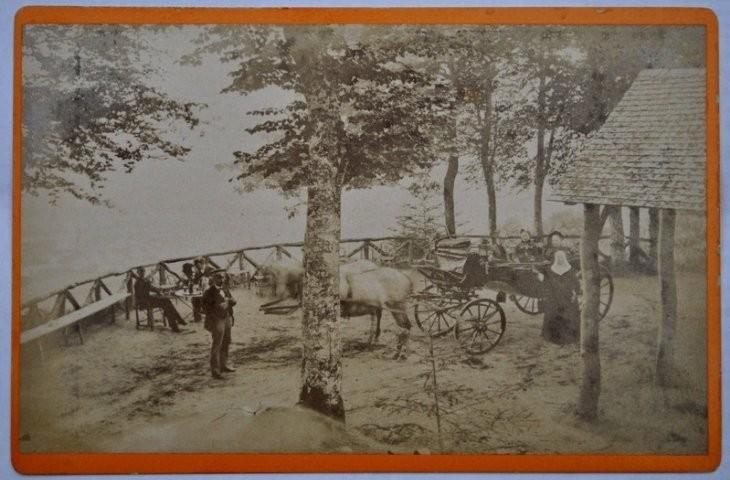
Feuillée Dorothée, before 1878 (coll. Christophe Toussaint, epinette.free.fr)
Fig.5
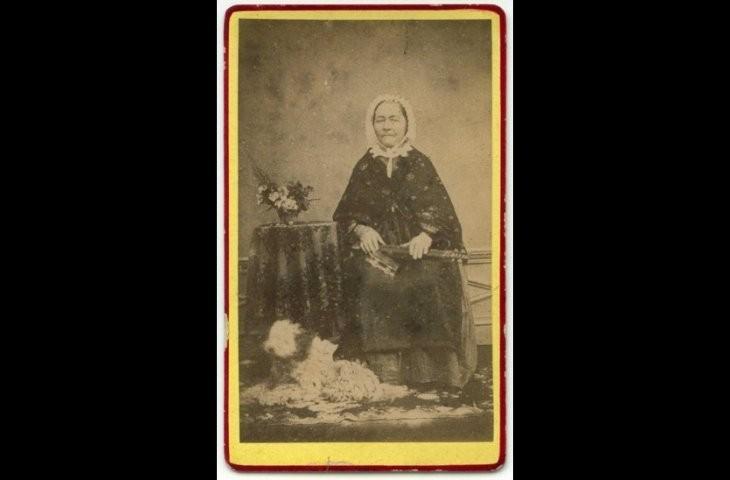
Dorothée Vançon (coll. Christophe Toussaint, epinette.free.fr)
Fig.6
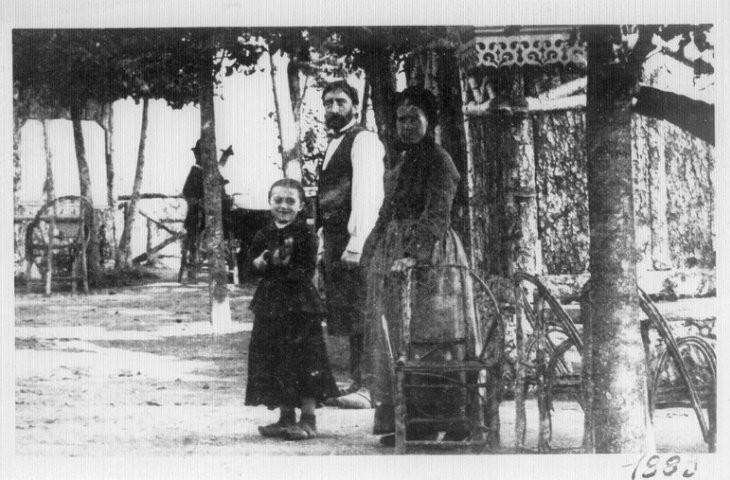
Feuillée Dorothée, 1883, Amé Lambert with his wife Amélie Cloléry and his daughter Gabrielle (coll. Christophe Toussaint, epinette.free.fr)
Fig.7
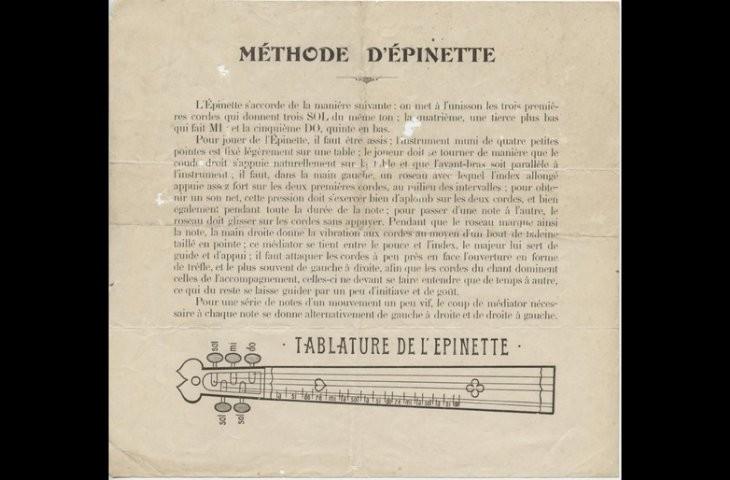
Method for the épinettes of Lambert, Val-d’Ajol, around 1910
Fig.8
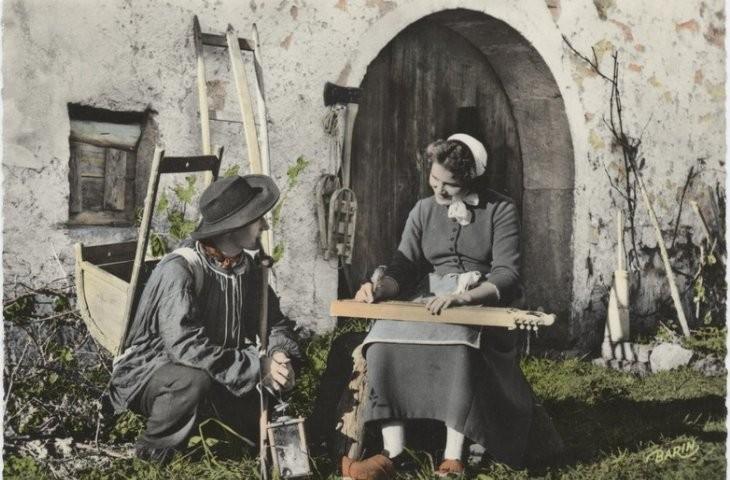
A tourist image of the Vosges: Sérénade à l’épinette des Vosges, postcard sent in 1959
Origins and establishment in the Vosges
The first drone zithers were probably made around 1500 in the Germanic north of Europe, most likely in northern Germany. In the sixteenth and seventeenth centuries, the instrument spread over a large part of the Germanic cultural area, and from there to several neighbouring areas as well. By the eighteenth century at the latest, it had also reached the Vosges, the French mountain range west of the Rhine, which forms the present-day border with Germany. In the Vosges, the new instrument was called ‘épinette’, after the other épinette, or spinet in English, an instrument of the harpsichord family that also belongs to the large family of plucked zithers. (1) Since the late nineteenth century, the folk épinette has often been called ‘épinette des Vosges’ to distinguish it from its aristocratic namesake. (2)
As is generally the case with épinette-like zithers elsewhere in north-western Europe, the épinette des Vosges is placed on a table and the player sits down. Traditionally, the strings are shortened with a stick held in the left hand and plucked with a plectrum in the right hand. (3) As elsewhere, the instrument was played for one's own pleasure or to accompany singing and dancing at family parties or gatherings of friends and neighbours in the evenings or on Sunday afternoons. (4) On Sundays, the épinette could also accompany religious songs. As it was typically played at home, the épinette was the only folk instrument that was often played by girls and women.
It has been suggested that the épinette was brought to the Vosges by Swedish or German soldiers during the Thirty Years' War (1618–1648), but concrete evidence is lacking. The fact that the folk and upper-class épinettes share the same name makes the interpretation of early written sources no easier. For example, not everyone is convinced that the oldest possible reference, in a church account from 1723, actually refers to the folk épinette. In that year, a curate from Gérardmer in the Vosges department purchased ‘Des Espinettes servant à apprendre des Écoliers à toucher des Orgues’ (‘espinettes’ intended to teach schoolchildren to play the organ) for the modest sum of 35 francs and 5 gros. (7)
It is equally questionable whether the ‘spalterium [sic] avec un jeu d’épinette taxé une livre’, which was listed in a 1730 estate inventory in Fougerolles (Haute-Saône department), refers to the folk instrument. (8) The term ‘spalterium’ and its relatively low value – equivalent to roughly one to two days' wages for a manual labourer – might well be indicative. (9) Or did that ‘jeu d’épinette’ rather refer to a set of toe cages used for fattening poultry? (10)
In any case, it is certain that the épinette had become commonplace in parts of the Vosges by the end of the eighteenth century. The oldest known player and maker of the instrument, Claude Joseph Vincent (‘le père Vincent’, Val-d’Ajol, 1753–1830), called the épinette ‘l’instrument de nos montagnes’. (11) The épinette was primarily made and played by farmers in the mountains; it was much less common in towns and valleys. (12) Val-d’Ajol and its surroundings would remain the core area of the épinette des Vosges tradition. The question remains why exactly the instrument took root in the Vosges, but not at all in the neighbouring Alsace region or elsewhere in Lorraine.
Dorothée Vançon and the rise of the épinette
In the course of the nineteenth century, the épinette grew into the musical emblem of the Vosges. This had everything to do with the development of spa tourism in the area. An excursion not to be missed by the spa guests of Plombières-les-Bains was a five-kilometre ride in a horse-drawn carriage or on an ox cart covered with foliage to the plateau des Charrières, high above the valley of the Combeauté, in the municipality of Val-d’Ajol. In the 1790s, the journeyman clog maker Jean-Baptiste Vançon had built a ‘feuillée’ up there, a country inn with a panoramic terrace beneath the foliage of the trees.
There, the beau monde enjoyed the simple pleasures of country life: a good glass of milk, home-baked rye bread, kirsch, cottage cheese and other local delicacies. But what made this feuillée so different was the beautiful voice and sparkling épinette playing of Dorothée, one of Jean-Baptiste’s eleven children. Dorothée Vançon (1805–1878) had quite a few distinguished visitors: from Louis XVI’s daughter Marie-Thérèse in 1828 to the emperor Napoleon III in 1856, 1858 and 1865, and the composer Hector Berlioz in 1856 and 1857. (13) Many visitors were so charmed by Dorothée’s épinette that they wanted to take one home as a souvenir.
The success of the épinette des Vosges was such that some skilful farmers in the neighbourhood took up épinette-making during the winter months. One of the most productive makers was Amé (officially Amant Constant) Lambert (1843–1908). During the winter months, he made up to 150 instruments, ready for sale during the summer tourist season. (14) In 1875, he bought the feuillée Dorothée, as he now called the spot, on a life-annuity basis (15) and developed it into a tourist centre with rustic chalets and, later, a hotel. (16)
The épinette on display: an instrument by Amé Lambert, circa 1895
This épinette is characteristic of Amé Lambert’s refined production in the years 1885–1895. His instruments from this period are about 60 cm long, have 17 frets for a diatonic tone scale (G-A-B-C-D-E-F-G-A-B-C-D-E-F-G-A-B-C), two unison melody strings (G), and three accompaniment strings tuned to a major triad (C-E-G). The strings are tuned with lateral wooden pegs. (17) Typical design features of this period are the elegant scroll and two soundholes in the shape of a heart and a four-leaf clover. The back bears a triangular brand mark with the words A. LAMBERT / FEUILLÉE / DOROTHÉE / VALDAJOL VOSGES. Amé Lambert used this mark around 1880–1900. (18)
The soundboard has a painting of a colourful garland, signed A.B. These are the initials of Albert Balandier (1872–1945), Amé Lambert’s artistic son-in-law. In 1895, Albert Balandier married Amé’s daughter Gabrielle, and he continued his father-in-law’s épinette workshop until the Great War. (19) Everything seems to indicate that this épinette was made around 1895.
The instrument was donated to the museum between 1914 and 1928 by a certain ‘Mme. J. Haps’. This undoubtedly refers to Marie Haps (1879–1939), née Marie Frauenberg, who was married to Joseph Haps, a Belgian financier. In 1919, Marie Haps founded a college of higher education for girls in Brussels. Her name lives on in the Faculté de traduction et d’interprétation Marie Haps Saint-Louis, a faculty that forms part of UCLouvain. (20)
Text: Wim Bosmans
Pierre Duval & Chantal Regennass-Lepaul, ‘La Valse de Dorothée’, on Epinette des Vosges, AVDAM Conseil général des Vosges, ILD 621004, 1992, track 12
Footnotes
(1) In the Vosges, the plural form ‘épinettes’ was much more common than the singular form ‘épinette’ well into the twentieth century (Michel 1978, p. 144).
(2) One of the earliest references can be found in Mahillon 1880, p. 350.
(3) Victor-Charles Mahillon learnt from N. Roussel, the organist in Val-d’Ajol, that the two melody strings were played in unison with a reed stick, but could also be played in two-part harmony using the fingers: ‘(…) en appuyant l’index sur la première corde et le médius sur la seconde lorsqu’on joue en tierces. Pour les autres intervalles on se sert des deux autres doigts.’ (Mahillon 1880, p. 351.) This is the only known documentation of finger playing in the nineteenth century.
(4) Grossier 1960, pp. 97–98.
(5) Michel 1960, p. 95; Michel 1984, s.p.; epinette.des.vosges.free.fr/Historique.htm (accessed 6 October 2026).
(6) One of the sceptics is Pierre Duval, as expressed on epinette.des.vosges.free.fr/Historique.htm (accessed 6 October 2026). The French musicologist Fabien Guilloux (IReMus, Paris) also tends to think that the reference is to a keyboard instrument. Such instruments were often used for music lessons in boarding schools, monasteries and schools. The relatively low price, which might suggest a folk instrument, does not necessarily represent the total cost (email to Anne-Emmanuelle Ceulemans, dated 15 February 2016). Michel 1978, p. 145, on the other hand, considers both the price and the plural form to be indications that the reference is to a folk instrument.
(7) A reproduction of this document can be found in Michel 1978, p. 157, and Dutertre 1997, p. 13.
(8) Quoted in Michel 1978, p. 145, and Michel 1968, p. 26.
(9) www.histoire-genealogie.com/Les-salaires-de-nos-ancetres?lang=fr.
(10) Oral communication by Pierre Duval, 13 August 2016.
(11) [Mengin-Fondragon] 1830, pp. 204–205 (quoted in Michel 1968, p. 27). The baron visited Père Vincent in 1817 (Dutertre 1993, p. 69).
(12) Michel 1984, s.p.
(13) Michel 1968, p. 27; Michel 1978, pp. 145–146.
(14) Michel 1968, p. 28; Michel 1978, p. 146.
(15) 1875, according to Michel 1968, p. 27.
(16) Michel 1968, p. 28.
(17) Until around 1885, Amé Lambert made shorter instruments (50–55 cm), without a scroll and with fourteen frets. From 1895 onwards, he replaced the wooden tuning pegs with metal tuning mechanisms (Michel 1968, pp. 28–29; Michel 1978, p. 146).
(18) L’instrument de musique populaire 1980, pp. 57 and 66.
(19) Until 1915, according to Dutertre 1997, p. 11, and Dutertre 1993, p. 79; until 1917, according to Christophe Toussaint (email, 9 August 2016). After the war, Albert Balandier bought the Hotel Windsor in Cannes. From then on, he divided his time between the Vosges during the summer season and the Côte d’Azur during the winter season, marking the end of his career as an épinette maker.
Bibliography
- Dutertre, Jean-François. ‘La leçon d’épinette’, in Les Ménestrels de Gérardmer, Arts et traditions de la Vallée des Lacs. Colmar-Kingersheim: Éditions SAER, 1978, pp. 159–164.
- Dutertre, Jean-François. ‘La belle ajolaise. Tourisme balnéaire et lutherie populaire’, in L’air du temps. Du romantisme à la world-music. Saint-Jouin-de-Milly: FAMDT, 1993, pp. 68–81. (Collection Modal.)
- Dutertre, Jean-François. ‘L’épinette des Vosges’, in Christophe Toussaint (ed.), Épinettes des Vosges et d’Europe. Catalogue de l’exposition. Socourt: Foyer Rural / Fédération Départementale des Foyers Ruraux des Vosges, 1997, pp. 7–17.
- Grossier, Jean. ‘L’épinette dans la Vallée des Lacs’, in Au Pays des Lacs. Arts et Traditions des Hautes-Vosges. Gérardmer: Les Amis du Vieux Gérardmer, 1960, pp. 97–105.
- L’épinette des Vosges. Fougerolles: ADDIM 70, 1984.
- L’instrument de musique populaire. Usages et symboles. Paris: Éditions de la Réunion des musées nationaux, 1980.
- Mahillon, Victor-Charles. Catalogue descriptif et analytique du musée instrumental du Conservatoire royal de Bruxelles (…). Gand: C. Annoot-Braeckman, 1880, pp. 350–351.
- Le baron de M. [Mengin-Fondragon]. Une saison à Plombières. S.l., 1830.
- Michel, Guy Jean. ‘L’épinette des Vosges’, in Au Pays des Lacs. Arts et Traditions des Hautes-Vosges. Gérardmer: Les Amis du Vieux Gérardmer, 1960, pp. 93–96.
- Michel, Guy Jean. ‘La fabrication de l’épinette des Vosges à Fougerolles et au Val d’Ajol du XVIIIe au XXe siècle’, in Mémoires de la Société d’agriculture, lettres, sciences et arts de la Haute-Saône, nouvelle série, no. 1. Vesoul, 1968, pp. 23–34.
- Michel, G.J. ‘La bûche à musique: épinette des Vosges’, in Les Ménestrels de Gérardmer, Arts et traditions de la Vallée des Lacs. Colmar-Kingersheim: Éditions SAER, 1978, pp. 140–158.
- L’épinette des Vosges. Website of the association L’épinette des Vosges of Plombières-les-Bains; texts by Pierre Duval. http://epinette.des.vosges.free.fr
- Épinette. Website of épinette maker and player Christophe Toussaint, from Dommartin-lès-Remiremont. http://epinette.free.fr
- Épinettes et cetera. Website of Jean-François Mazet. https://epinettesetcetera.com/