April 2026
Fig.1
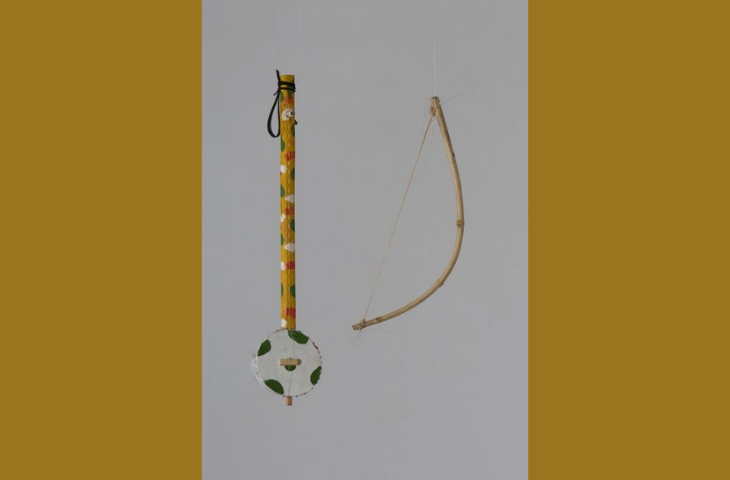
Orutu, Kenya, 2012, inv. 2012.087.001
Fig.2
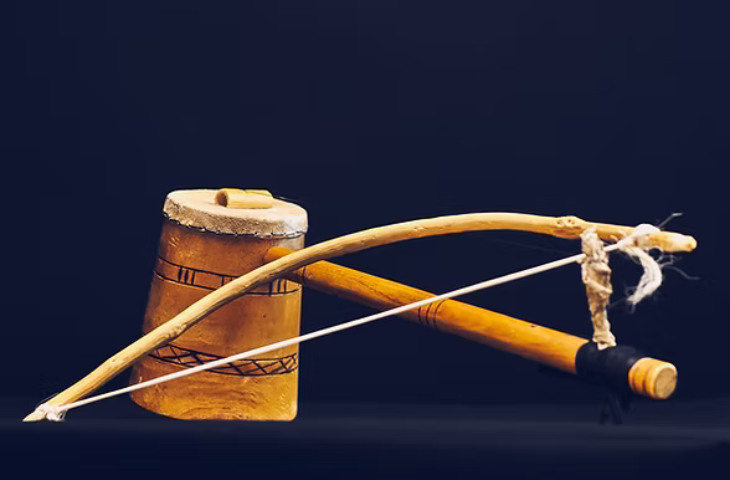
Orutu, © Nyatiti NyaDala CIC
Fig.3
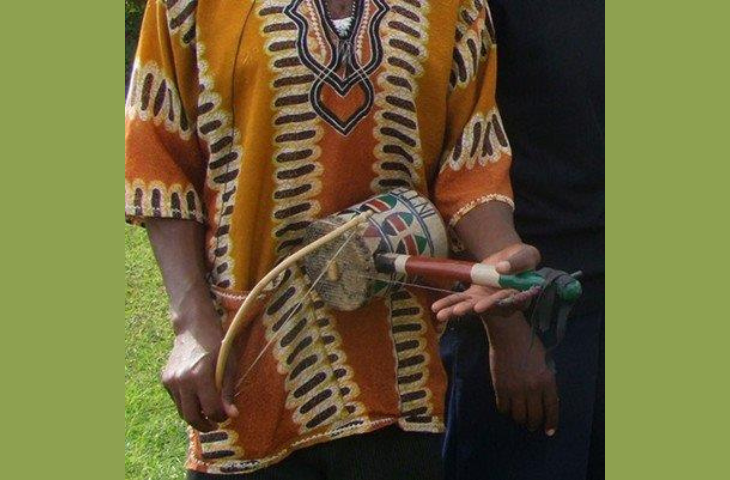
Orutu, extract of “The singing wells project”, Otacho Young Stars, 2012, © Singing Wells
Fig.4

Labdi Ommes, © Mud Journal
An instrument between tradition and modernity
This striking orutu, purchased in Nairobi in 2012 for the MIM collection, represents one of the most emblematic instruments of the Luo community of western Kenya. Made by Japheth Owuor Blasto, an instrument maker and music instructor, it offers a contemporary interpretation of a long-standing musical tradition.
The cylindrical resonator, fashioned here from a plastic tube for durability, is covered with goatskin tightly nailed to the body. The neck is painted yellow and decorated with bright white, red, and green dots, echoing decorative styles common in modern Luo craftsmanship. A single metal string, repurposed from a motorcycle brake cable, stretches from a curved metal tuning pin at the top of the wooden neck to a small peg at the base. A loose bamboo bridge rests on the membrane, transmitting the vibration of the bowed string into the resonator, while a rubber loop near the tuning peg helps stabilize the player’s hand.
Despite these modern materials, the instrument’s form and sound follow the principles of the older orutu, traditionally carved from soft wood and covered with monitor lizard skin. Its one-string design enables a highly expressive, voice-like tone, achieved by bowing with sisal fibers treated with tree resin. Musicians use three or four fingers of the left hand to stop the string, shaping a melodic line capable of mimicking speech or singing.
Use, decline and revival
The orutu has long been at the heart of Luo musical life, played at festive gatherings, storytelling sessions, dances, and communal ceremonies. It often appears alongside ohangla drums, the nyangile metal soundbox, and the ringing ogengo metal ring. Though orutu music once flourished across rural western Kenya, colonial suppression of African cultural forms and the spread of Western instruments led to a decline in its popularity. Today, many Kenyans know the orutu more as a cultural symbol than as a living musical practice.
Yet the instrument has returned to contemporary stages. The orutu now plays a central role in the benga style, and ensembles such as Kenge Kenge Orutu System have contributed to its revival. Kenyatta University’s Music and Dance Department also plays an active role in this revival by encouraging the rebuilding and performance of traditional instruments and dances, as well as documentation projects such as Singing Wells.
The tradition is also undergoing a powerful shift in terms of gender. Historically restricted to male musicians, the orutu is now played by a new generation of women who challenge these norms. Among them are Labdi Ommes and Lorna Ochieng, two of the few professional female orutu players in Kenya. Their work confronts the gendered expectations surrounding the instrument while inspiring younger musicians to reclaim and reinterpret their cultural heritage.
A tradition in motion
This instrument captures both the continuity and transformation of the orutu tradition. Its modern materials speak to adaptation and innovation, while its sound continues to carry the emotional depth and narrative power that have defined Luo music for generations.
Text: Nele Libbrecht
Bibliography
- CGTN Africa. (2022, February 14). Kenyan Luo traditional instrument: Orutu. [Video]. YouTube. Retrieved 4 Mar. 2026, from https://www.youtube.com/watch?v=1hDiCwf_wag
- Darkwa, A. (1985). Traditional Music and Dance in Luo Community Life. Anthropos, 80(4/6), 646–653. http://www.jstor.org/stable/40461065
- DW. (2023, June 2). Being a female Orutu player in Kenya. [Video]. dw.com. Retrieved 4 Mar. 2026, from https://www.dw.com/en/being-a-female-orutu-player-in-kenya/video-65718123
- Hulshof, C., Siebert, X., Melot, H. (2016). NeoMI: a New Environment for the Organization of Musical Instruments. In 6th International Workshop on Folk Music Analysis.
- MIM, B. (1984). The new Grove dictionary of musical instruments (S. Sadie, Ed.). Macmillan Press Limited.
- MIMO. (n.d.). Skosmos: InstrumentsKeywords: Orutu. Retrieved 4 Mar. 2026, from https://vocabulary.mimo-international.com/InstrumentsKeywords/en/page/8298
- Nyatiti NyaDala. (n.d.). Orutu | African Fiddle | Wandindi | Ishiriri | One string Fiddle. Retrieved 4 Mar. 2026, from https://www.nyatitinyadala.com/orutu
- Ogola, E. O. (1995). Afro-classics from Kenya: A special case of the Luo. Retrieved 4 Mar 2026, from http://ir-library.ku.ac.ke/handle/123456789/4504
- Omenya, G. (2018). Engendering Music: Changing Trends of Music Performance and Dance in Luo Nyanza. Music and dance in Eastern Africa: current research in humanities and social sciences, 103-118.
- Orawo, C. N. (2024). Effects of migration on music traditions of the Communities of African Great Lakes Region. Journal of Creative Arts, Communication and Media Studies, 2(1), 4–29. https://doi.org/10.33886/jccm.v2i1.462
- Organology: Musical Instruments Encyclopedia. (2025). Orutu. Retrieved 4 Mar. 2026, from https://organology.net/instrument/orutu/
- Thorne, T-J. (2023). Labdi Ommes: Before and after the orutu. Retrieved 4 Mar. 2026, from https://mudjournal.org/2023/04/25/labdi-ommes-orutu/
- Wamalwa, P. L. (n.d.) The Orutu. Retrieved 4 Mar. 2026, from https://creativesgarage.org/the-orutu