March 2026
Fig.1
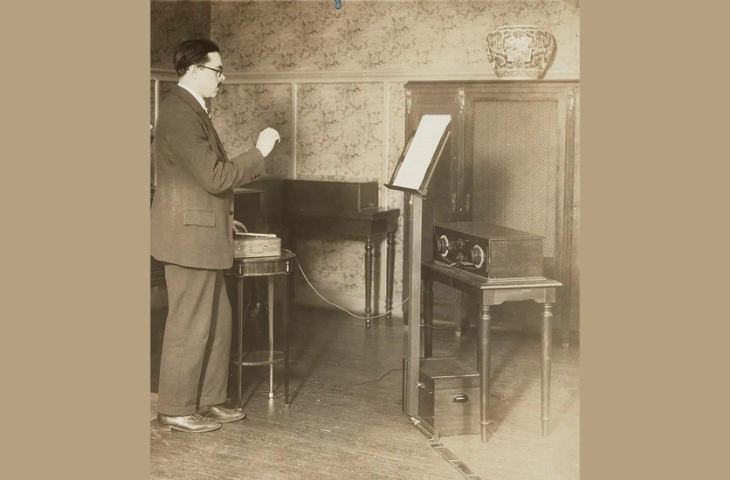
Ondes Martenot, modèle no. 1, Philharmonie de Paris - Musée de la musique, Fonds Martenot, E_2019_9_1_6_1_82_P0001
Fig.2
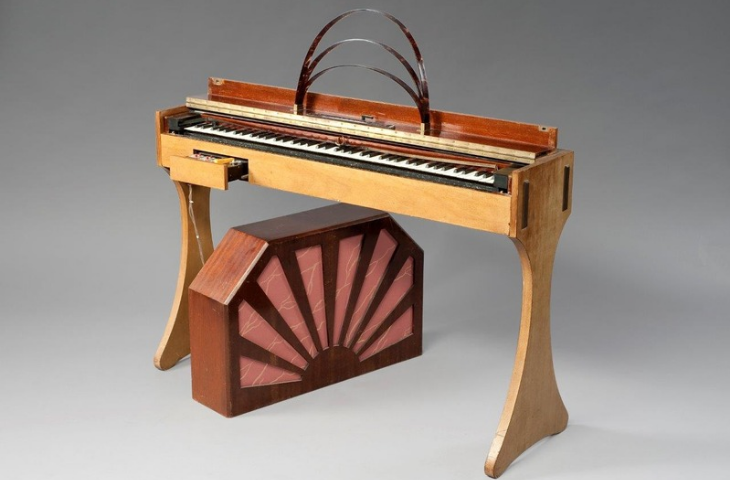
Ondes Martenot, modèle no. 5, Maurice Martenot, Neuilly-sur-Seine, 1939, inv. JT0179
Fig.3
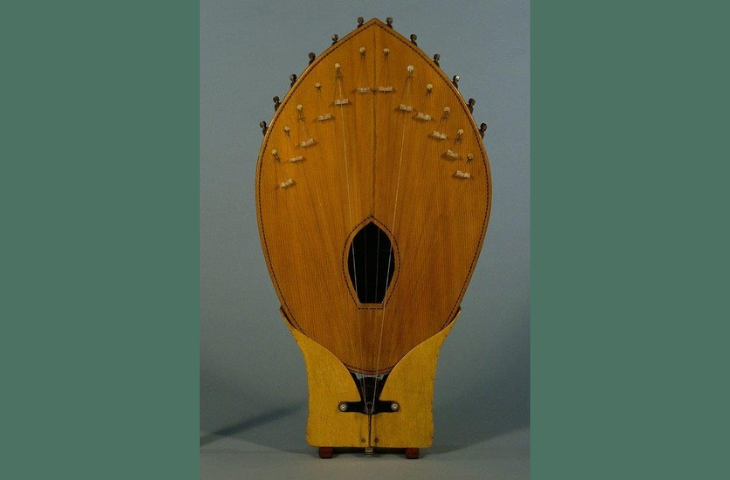
The 'palme' uses tunable sympathetic strings, © Jean-Marc Anglès
Fig.4
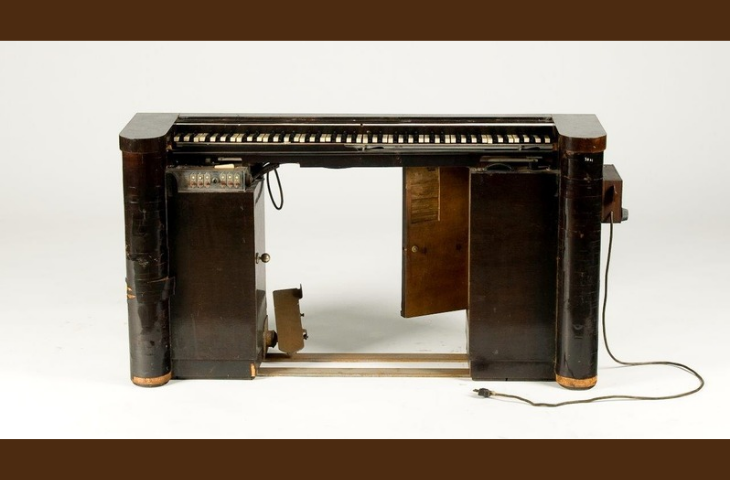
Ondes Martenot, Maurice Martenot, Neuilly-sur-Seine, 1936, inv. 3871
Origins and mechanics of the Ondes Martenot
The Ondes Martenot is an electronic instrument, meaning that its sound is generated electronically. In the Ondes Martenot, this occurs through oscillators. To produce sound, Maurice Martenot employed the heterodyne principle. This principle combines two high-frequency oscillations to produce new frequencies corresponding to the sum and the difference of the original frequencies. The sum of the two frequencies is inaudible, but the difference between them is audible.
The Ondes Martenot made its debut on May 3, 1928, at the Paris Opéra. After performances in Paris and Amsterdam, Maurice Martenot presented his new instrument in Brussels on May 30 and 31. At those first concerts, he used a prototype (fig.1) that bore little visual resemblance to the later version of the instrument (fig.2), but the basic principle remained unchanged: a metal wire, moved with the right hand, determined the pitch, while the left hand altered the timbre using buttons.
Around 1930, an important change in playing technique occurred: the musician no longer performed standing at a music stand, but seated at a keyboard that could also function as an independent playing mechanism (from modèle no. 4 onward). Martenot’s great attention to sound reproduction resulted in the development of his own loudspeakers during the 1930s and 1940s, including the famous palme (fig.3).
Repertoire development and recognition
In the early period, Martenot demonstrated his instrument’s possibilities primarily through arrangements of classical works. The reception was enthusiastic among technicians, musicians, composers, and the general public alike.
However, to make the leap from technical curiosity to an accepted musical instrument required a dedicated repertoire. Where this proved a stumbling block for many inventions, it was less of a problem for the Ondes Martenot: between 1928 and 1939, thirty-four compositions were written for the instrument, all by French composers.
Its innovative sonic possibilities also attracted film composers, with notable roles in L’Idée by Barthold Bartosch (1932) and Liliom by Fritz Lang (1934). After World War II, the Ondes Martenot definitively established itself as a fully fledged musical instrument, both in art music and in film and popular music. In the popular sphere, Jacques Brel’s interest stands out, as does that of Jonny Greenwood, who not only regularly employs the instrument in Radiohead but has also incorporated it into his classical compositions.
The Ondes Martenot at the MIM
The MIM possesses two Ondes Martenots, registered under inventory numbers 3871 and JT0179.
The first instrument (3871) was purchased in 1936 by engineer Robert Haerens and donated to the museum in 1964 by his daughter, after the death of her mother, the artist Louisa Robelius. In Maurice Martenot’s archives, the instrument is described as a “modèle spécial adaptable au piano” (fig.4).
The second instrument belonged to civil engineer Henri Féron, who purchased it in 1939 (fig.2). This specimen is a modèle 1937, also known as modèle no. 5. This type of instrument was developed with support from the French government in connection with the Paris World’s Fair.
Text: Wim Verhulst