January 2026
Fig.1
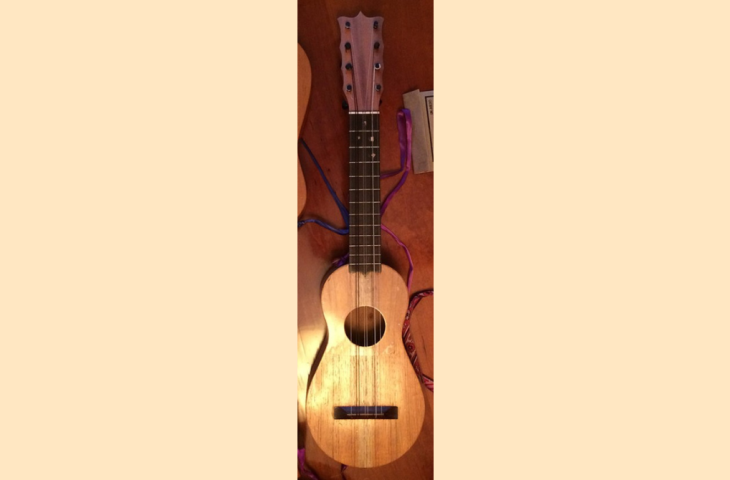
Traditional Jarana ©Center for World Music
Fig.2
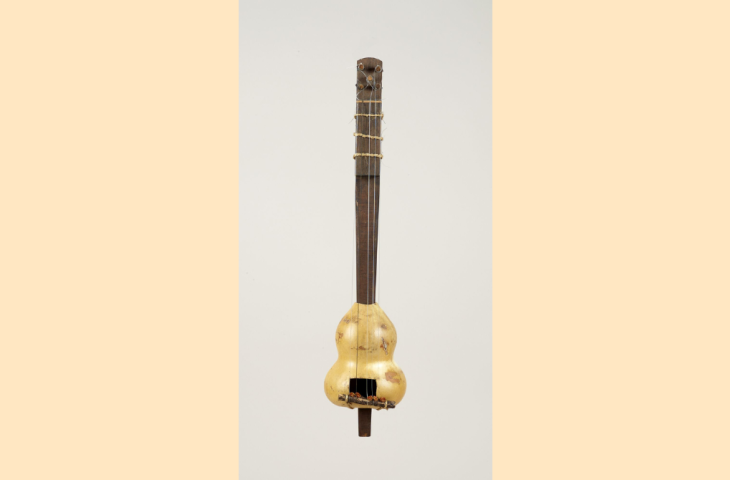
Jarana, Mexico, before 1972, inv. 1972.045
Fig.3
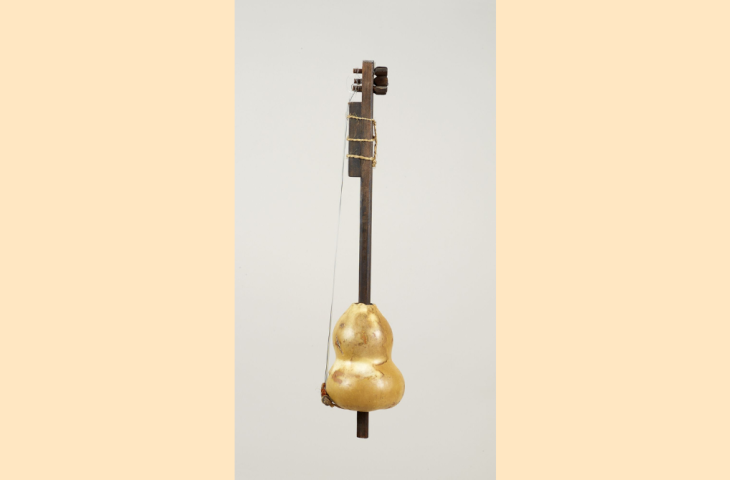
Jarana, Mexico, before 1972, inv. 1972.045
The Mystery of the Lacandón Jarana
While working on an ongoing project, we realised that one of our instruments was rather unique. The instrument we have been calling “jarana” ever since it came to us in 1972 displays none of the traits of that instrument. Typically, this Mexican family of string instruments has a neck, pegbox and body all carved from a single piece wood (fig.1). The instrument arose in Veracruz, Mexico, and was adapted from baroque guitars brought over from Spain by colonists. The high humidity in Veracruz caused baroque guitars to warp and crack. The carving method was developed to make the instrument more resistant to the Mexican climate. Our jarana (fig.2 and 3), by contrast, is made from a gourd, with a rectangular sound hole near the bridge. The neck is set through the gourd and protrudes from the bottom of the instrument. The neck also features a small fretboard, which covers about a third of the neck and features three frets fashioned from rope. The bridge is tied on to the protruding neck with the same rope used for the frets. The bridge and frets are not straight, which could be due to the instrument’s presumed age, damage during handling, or less-than-stellar craftmanship. The instrument is strung with five nylon strings (which may or may not be original) tuned with friction pegs.
Gourd instruments in Africa and the Americas
Instruments made from gourds have been used all over the world for millennia. In Africa, instruments like koras, ekontings, imzads, ruudgas and banjars were (and still are) constructed using gourds for the soundbox. The gourd is cut open on one side to provide a space for a piece of animal hide to be stretched over. When played, the stretched hide amplifies the vibrations from the strings, thereby increasing the volume.
In South America, pre-colonial string instruments were limited to the musical bow, but gourds were used to make things like rattles and shakers. Knowledge of gourd string instruments was brought to the New World by slaves from Africa. The banjar for instance, eventually evolved into the modern-day banjo. In South America, sources indicate that an instrument called “banza” was played in San Salvador by Gregório de Mattos, who lived until 1696. Although the banza has an animal hide to provide amplification of vibration, it is like our “jarana” in that it also has a neck set through the gourd, protruding at the bottom.
The Lacandón
The MIM knows little about our “jarana.” The only facts of its history are that it was acquired in 1972, that it was given the name “jarana,” and that it originates with the Lacandón society in Chiapas, Mexico. The Lacandón, which only number around six hundred people, are descendant from Mayas who fled into the rainforest to escape the conquistadors. Due to their isolation, they were spared the worst of colonizing influences. Although not totally uncontacted by the rest of the world, contact only started to pick up in the early 20th century. Music plays an important role in Lacandón religious practice. Their music is mostly vocal, although rattles and shakers made from gourds are also used. Crucially however, the Lacandón do not traditionally play string instruments, and more current accounts also make no mention of string instruments. This fact makes the origins of our “Lacandón jarana” all the more puzzling.
The MIM's jarana
Increased contact with the outside world in the early 20th century meant an increasing need for money. Of the six hundred Lacondón, around ten percent travel to nearby cities and towns during tourist season where they sell souvenirs. Most of these souvenirs are replica hunting bows as well as mock-religious items. These items are low quality recreations of their cultural heritage, meant to be sold. It is possible that one of these Lacandón merchants saw or acquired a jarana and attempted to recreate it, either for their own personal use, or to be sold as a souvenir. The latter theory is supported by the fact that the Lacandón are able to carve canoes out of a single tree, which means that they likely have the skills to make a more traditional jarana. Furthermore, the apparent crudeness of the Lacandón jarana is not at all in line with other artifacts from the Lacandón, which display considerable craftmanship. Although our archive is clear in that it names the Lacandón as the producer of the instrument, it is also possible that, when the instrument was precured by the museum, it was mislabeled. It could for instance have been acquired near or in the Lacandón forest but made by someone not belonging to the Lacandón people.
Naturally, most of this is speculation, and some knowledge is likely lost forever, such is the reality of the museum work. However, with more research, it might be possible to get a better picture of the true history of the Lacandón jarana.
Text: Ruud Wiggers
Bibliography
- Bourg, Cameron Hideo. (2005). Ancient Maya music now with sound. https://repository.lsu.edu/cgi/viewcontent.cgi?article=4497&context=gradschool_theses
- Project - DOBES. (November 14, 2013). DOBES. https://dobes.mpi.nl/projects/lacandon/project/
- Vilela, I. (2010). The singing guitar, yo. https://www.scielo.br/j/ea/a/wm9KZc6QwxJPRpqDtdfxMcb/?format=pdf&lang=en.
- Wallenfeldt, Jeff. (n.d.) Brittanica
- https://www.britannica.com/topic/Lacandon
- Whitaker, W. and Cutler, Hugh C. (April 4, 1961). History and Distribution of the Cultivated Cucurbits in the Americas.https://www.jstor.org/stable/pdf/278735.pdf
- Takada, Y. (2016). Bluesman, Guitar, And Migration. https://egrove.olemiss.edu/cgi/viewcontent.cgi?article=2159&context=etd
- Budasz, R. (February 1 2007). Black guitar-players and early African-Iberian music in Portugal and Brazil. https://doi-org.utrechtuniversity.idm.oclc.org/10.1093/em/cal117