August 2026
Fig.1
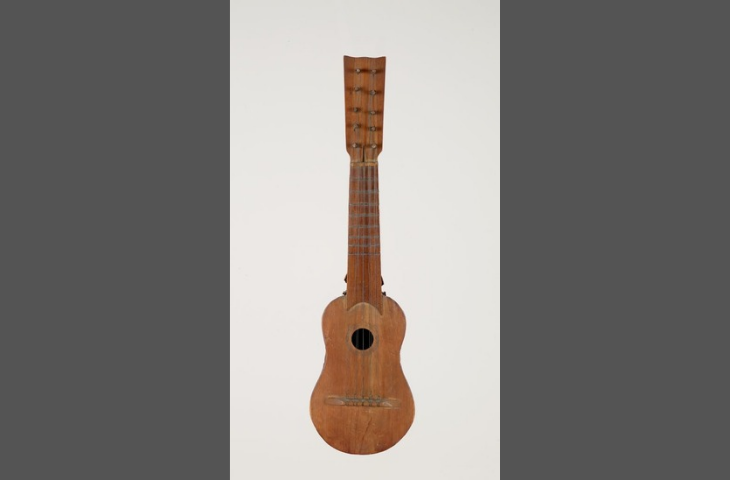
Charango, Peru, before 1928, inv. 3383
Fig.2
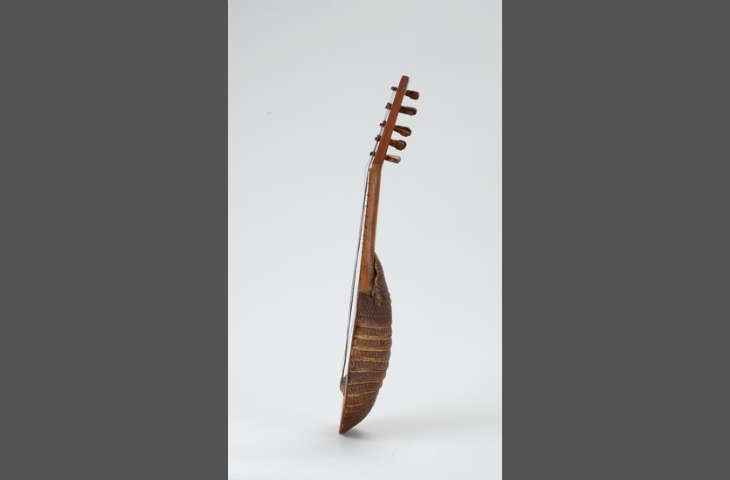
Charango, Peru, before 1928, inv. 3383
Fig.3
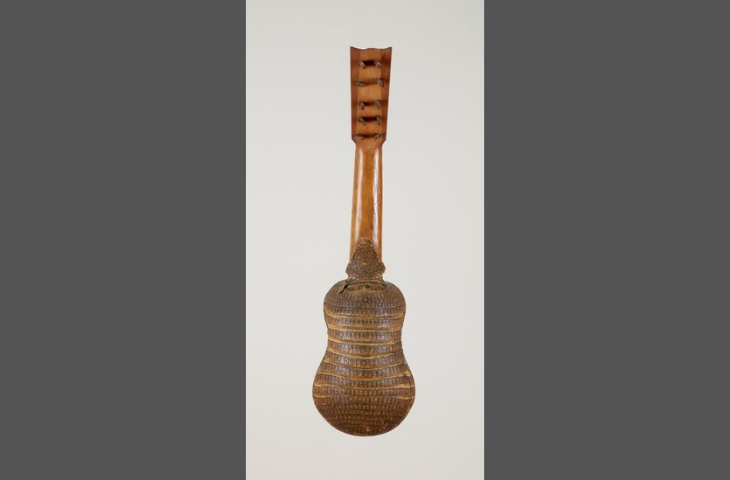
Charango, Peru, before 1928, inv. 3383
The Andean charango
The charango is the Spanish guitar's little South American brother. The instrument is thought to have originated some three hundred years ago in the "silver city" of Potosí, in what is now Bolivia. It may have been devised by Indigenous musicians after the example of the guitars or mandolins of the Spanish conquistadors. The story goes that the Indigenous musicians lacked the technology to shape a wooden soundbox, so they used the shell of an armadillo.
The charango spread from the Potosí region along the major trade routes across much of the Andes, taking root in Bolivia, Peru and northern Argentina. It is still a favourite dance instrument, played both solo and in ensembles.
In its current, most prevalent form, the charango has a wooden, guitar-shaped soundbox, is approximately 65 cm long, and is strung with five double strings. However, there are also variations with, for example, four single strings or five courses of three strings. What is unusual about the charango is that, generally speaking, all its strings are tuned within one octave. This is what gives the instrument its compact and penetrating sound.
This old example belonging to the MIM (fig. 1) - one of eight charangos in our collection - comes from Peru. The instrument still has the traditional shell of an armadillo (figs. 2 and 3), and it has five double metal strings. This charango was donated to the MIM by the musician and composer André Sas Orchassal (Paris, 1900 – Lima, Peru, 1967), together with six other Peruvian instruments.
The charango in the MIM collection
André Sas studied the violin at the Brussels Conservatory. He then continued his studies in Paris, where he became proficient in harmony, counterpoint and fugue.
At the age of just twenty-four, he was recruited by the Peruvian government to teach the violin in Lima and to lead the orchestra of the National Academy of Music there. Sas immersed himself in traditional Indigenous music, published works on the subject, and also drew inspiration from it for his own compositions.
After becoming a naturalized Peruvian citizen, Andrés Sas, as he was now known, rarely returned to Europe. However, we do know that he was in Brussels in 1928. Perhaps it was then that he brought the instruments with him and donated them to the MIM. Sas had studied the history of music under the then curator Ernest Closson, so they were well acquainted.
Text: Wim Bosmans