June 2026
Fig.1
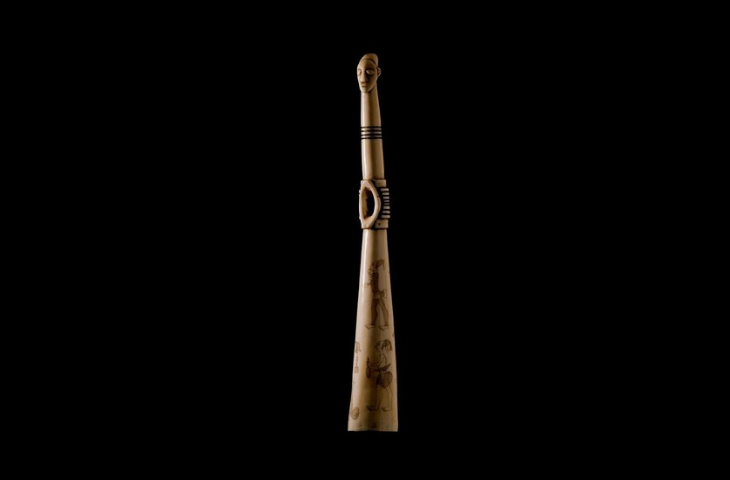
Horn, inv. 1983.033
Fig.2
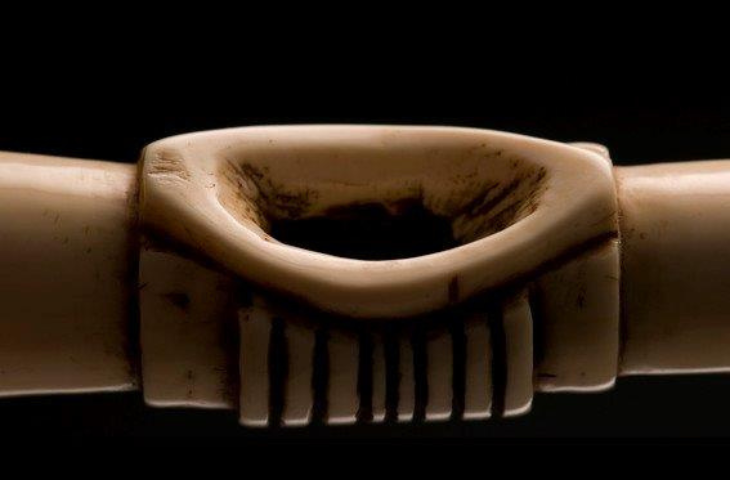
Horn (detail), inv. 1983.033
Fig.3
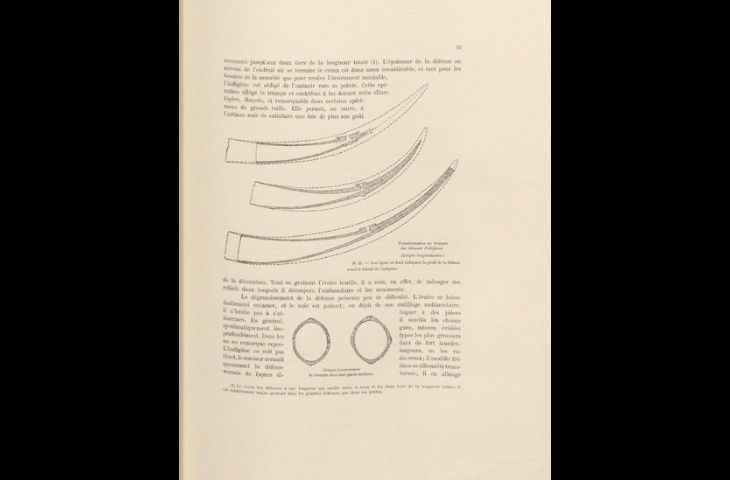
Copy of a drawing of a cross section of an elephant tusk and the outline of a horn cut out from it (Notes analytiques sur les collections ethnographiques du Musée du Congo, Brussels, 1902, tome 1, fascicule 1, p. 93)
Fig.4
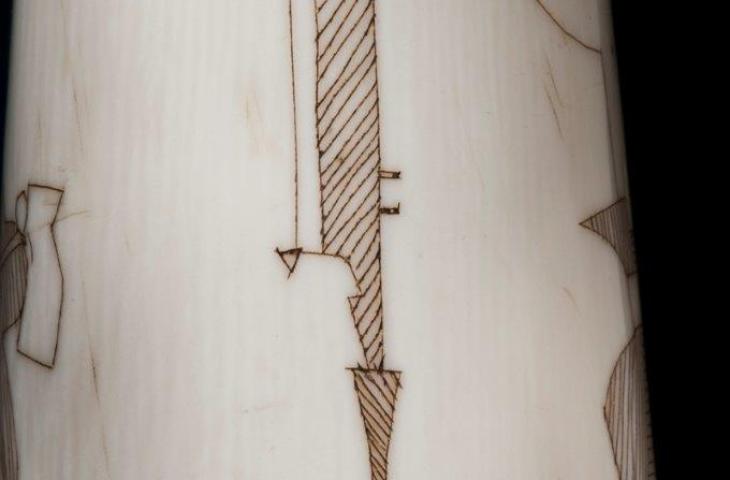
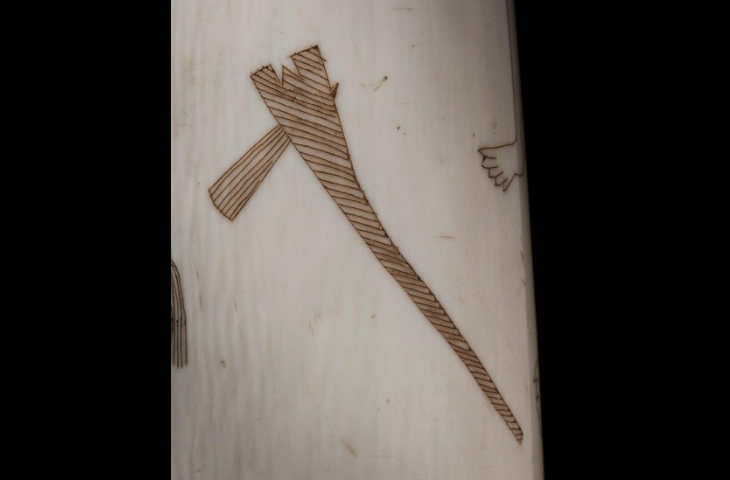
Detail of horn 1983.033: an adze and a knife engraved on the bell of the horn, inv. 1983.033
Fig.5
“Saza, an Avongara expert in carving and engraving ivory, with his wife, a Makere, and an Azande man”, Poko, ca. 1912. Photo: Herbert Lang. Image no. 111657, AMNH Library
Fig.6
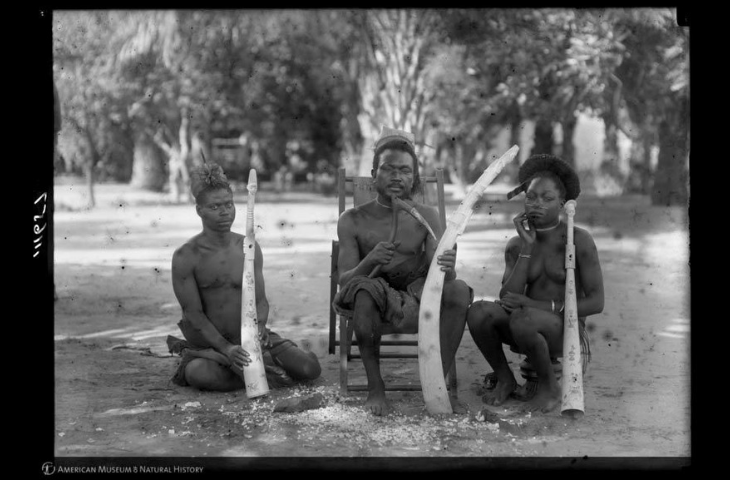
Plate from the court of King Mbunza, in Schweinfurth, The Heart of Africa, vol. 2, New York, 1874, facing p. 74: “King Munza dancing before his wives.”
Fig.7
![Plate from Schweinfurth, Artes Africanae, Leipzig–London: “Niam-Niam [= Mangbetu]”](/sites/default/files/styles/slideshow_browser/public/2026-06/20260602_101355_0000.png?itok=69aqtZzw)
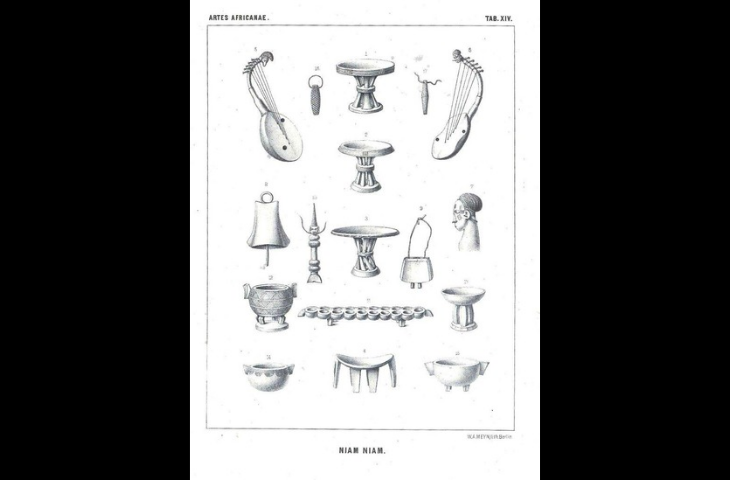
Plate from Schweinfurth, Artes Africanae, Leipzig–London: “Niam-Niam [= Mangbetu]”
Fig.8
Details of male and female figures on horn, inv. 1983.033
A Mangbetu ivory horn
This horn entered the MIM in the summer of 1983. According to Émile Deletaille, the Brussels dealer in ethnographic art who sold the instrument to the museum, the horn was quite old, most likely dating from the beginning of the 20th century, and of high prestige. Fine figurative drawings, “extremely naïve, although full of humour”, were engraved on the body.
The maker carved the horn from an elephant tusk: he removed a considerable amount of ivory to produce a straight, small instrument, while keeping the mouthpiece and the decorative head at the top of the horn thicker. The rim of the bell is paper-thin.
The instrument was produced by the Mangbetu, a powerful Bantu-speaking population who lived in the Uele River region in the northeast of the present-day Democratic Republic of the Congo. Ivory horns were crucial attributes in Mangbetu court life. Part of the chieftain’s regalia, the nambrose (namburuse) or nekpanzi, as they seem to have been called in the region, were made solely on his command. Symbolising his power and leadership, they served as signalling instruments, announcing his arrival and departure, as well as his war victories, and were blown when visiting neighbouring chiefs. They also featured in the court orchestra, together with wooden slit drums, kettle drums, metal bells, and rattles. They were played in pairs during court ceremonies celebrating the king, and during court dances, including those in which the king himself danced to demonstrate his skills, since good dancing was equated with intelligence and the ability to rule. Horns also served as diplomatic gifts representing the wealth of the polity and establishing relationships with neighbouring chiefs; such instruments were high-status commissions not necessarily intended to be played.
The making of these horns was entrusted exclusively to smiths, a protected, wealthy, and feared caste. They possessed the metal tools required to carve ivory. Gaetano Casati, the Italian cartographer travelling through the region in the early 1880s, observed such carved ivory objects and later wrote:
“The elegance of all these objects might suggest the idea that the tools used are perfect or nearly so; but it is astonishing to see how admirably these people can carry out the ideas which their inventive minds conceive, with such imperfect and primitive means” (Ten Years in Equatoria, 1891, I, 125).
The initial rough shaping of the horn was done with an axe, and further carving with an adze. For finer details, a knife with a long handle and small blade was used. Finally, the ivory surface was smoothed with a moistened leaf with a sandpaper-like texture. Images of the adze and knife used in carving are engraved on the MIM’s example. The production of a horn could take more than two months.
Music and power at the court
These large court horns were held horizontally when played, and blowing them required considerable physical effort. Ivory horns were played in ensembles of two or more, using the hocket technique. Each horn produced a single note; the resulting polyphony emerged from the coordinated interaction of the players. When the German explorer Georg Schweinfurth visited King Mbunza’s court in 1870, he reported:
A couple of horn blowers stepped forward and proceeded to execute solos upon their instruments. These men were advanced proficients in their art, and brought forth sounds of such power, compass, and flexibility that they could be modulated from sounds like the roar of a hungry lion or the trumpeting of an infuriated elephant down to tones which might be compared to the sighing of the breeze or to a lover’s whisper. One of them, whose ivory horn was so huge that he could scarcely hold it in a horizontal position, executed rapid passages and shakes with as much neatness and decision as though he were performing on a flute (Heart of Africa, 1874, II, 49–50).
The Mangbetu horn in the MIM arrived more than 35 years ago but must have been made more than a century ago. Ivory horns such as this one, with engraved images on the body, began to circulate among Western collectors from around 1915, most likely due to the taste of a particular explorer.
The collection of Mangbetu objects
Collecting objects of material culture in the Uele region began on a large scale in the 1890s, when the administration of Leopold II’s Congo Free State extended into the northeast of the country. Since Schweinfurth’s publications on the Mangbetu in the 1870s, Western collectors had become fascinated by the region’s artistic production. The illustrations in Schweinfurth’s seminal Artes Africanae (1875) stimulated “colonial museums” in Europe and the United States, newly founded at the end of the 19th and beginning of the 20th century, to acquire Mangbetu and neighbouring objects in situ.
Herbert Lang, the Baltic-German leader of the Congo expedition organised by the American Museum of Natural History (AMNH) in New York, shipped almost 4,000 ethnographic objects to the museum between 1909 and 1915. Lieutenant Armand Hutereau, commissioned by the Belgian government to undertake an expedition in northeastern Congo, collected more than 10,000 objects for the Musée d’Afrique in Tervuren between February 1911 and June 1913. In 1907, about 800 pieces from the Uele region had been given to the AMNH by King Leopold II, who sought to promote his colony in the United States and later co-financed Lang’s expedition. Enid Schildkrout, curator emerita of the AMNH and researcher of Lang’s Congo expedition, estimates that at least 20,000 objects left the region by 1915. This sudden Western interest had a profound impact on local production, affecting both quantity and form.
The birth of a new figurative art
Before colonial contact, the Mangbetu did not have a tradition of anthropomorphic figurative art. Their ivory horns were not decorated with sculpted heads or engraved drawings; notably, no such horns appear in Schweinfurth’s Artes Africanae. The rise of figurative Mangbetu art in the late 19th century is linked to European demand, as figurative work aligned with Western aesthetic preferences. Chiefs began to encourage carvers to add human figures to objects, a practice already present among neighbouring Azande. Mangbetu and Azande artists quickly integrated distinctive figurative forms into jars, knives, boxes, hairpins, and horns. Objects featuring elongated heads became prestigious icons of “typical” Mangbetu art, interpreted by Europeans as evidence of a connection to ancient Egyptian civilisation. Niangara, Poko, and Rungu—originally colonial administrative posts—became important production centres and cosmopolitan hubs where European presence attracted Mangbetu and Azande artists.
Lang in particular developed a strong interest in figurative art during his stay in the Uele region. According to Schildkrout, unlike other expedition collectors, he spent long periods at the same posts. In Niangara, Rungu, and Poko, he built close relationships with local rulers. Chiefs such as Okondo and Senza mediated between Lang and local artists, encouraging the production of anthropomorphic objects that matched his preferences. Eventually, Lang established direct relationships with specific artists and appears to have suggested the inclusion of drawings depicting scenes from Mangbetu daily life. This led to ivory horns with figurative engravings on the bell—an innovative form of musical instrument conceived as an art object rather than primarily for performance.
The engravers of Poko
Between 1910 and 1915, an increasing number of horns destined for export were produced. Since neither sculpture nor drawing held particular symbolic meaning for the Mangbetu, and since these horns lacked specific ritual or spiritual significance, they could be produced serially without conceptual constraints.
At least two artists became specialists in engraving horns, boxes, jars, and knives: Zaza (Saza) and Songo. Both were Azande artists living in Poko who regularly signed their work. It is unclear whether other engravers existed. The drawing style is remarkably consistent, likely due in part to the guidance of the same patron, Herbert Lang.
The drawings represent scenes from Mangbetu social and material life, depicting animals, plants, tools, and activities such as hairdressing, instrument-making, eating, resting, working, hunting, quarrelling, and fighting. They also reflect gender relations, politics, technology, and interactions with Europeans. The engravings on the MIM instrument—possibly by Zaza or Songo—include stylised depictions of two Mangbetu men and two Mangbetu women with elongated heads and fan-shaped coiffures, as well as a knife, an adze, a bird, and a snake. In this way, Mangbetu artists offered Western museum audiences a mediated image of their world.
An export object
Not all engraved horns were sent to the AMNH. The MIM horn was likely made during or shortly after Lang’s presence in Mangbetu territory and probably acquired by a European in Poko, Rungu, or Niangara. Such objects are still found in private collections and occasionally appear at auction.
With the death of Chief Okondo and the departure of Herbert Lang, no new artists continued this form. Ivory carving declined in subsequent decades, and engraved ivory horns fell out of use. With the passing of the generation of Songo and Zaza, figurative Mangbetu ivory art ceased by the 1930s. As Schildkrout notes, “Once the system of colonial rule became firmly established, chiefs were less inclined to use art to win favour with colonial officials” (African Reflections, 259).
A witness of early colonial contacts
It is clear that the MIM horn was an export object for the Western market, produced after 1910 and no later than the 1930s. Its small, straight form suggests it was designed for easy transport to Europe. It is a so-called “proto-tourist” object, created in an African–Western contact zone and shaped by European influence. Notably, among the more than 10,000 objects collected by Hutereau and now held at the Royal Museum for Central Africa in Tervuren, none are ivory horns with engraved images, suggesting a selective collecting focus on “authentic” pre-contact forms.
The MIM horn belongs to a limited series of instruments from the early colonial period, when African artists engaged directly with Western collectors and incorporated visual narratives into their work. The engraved scenes reflect how Mangbetu artists of the early 20th century represented their world to European audiences.
Text : Saskia Willaert
Bibliography
- MIM Archives, invoice Émile Deletaille, 10-06-1983, ‘African Ethnographic Collection’ on the website of the American Museum of Natural History, New York (amnh.org/our-research/anthropology/collections/collections-history/african-ethnography)
- Burssens, Herman, Mangbetu. Afrikaanse hofkunst uit Belgische privé-verzamelingen, Brussels, Kredietbank, 1992
- Casati, Gaetano, Ten Years in Equatoria and the Return with Emin Pasha, 2 vols., London, 1891
- Couttenier, Maarten, Congo tentoongesteld. Een geschiedenis van de Belgische antropologie en het museum van Tervuren (1882–1925), Louvain, 2005
- Demolin, Didier, Mangbetu-Zaire, notes LP, Paul Collaer, Centre ethnomusicologique, Royal Museum of Central Africa, ECPC03, Tervuren, 1985
- Demolin, Didier, ‘Music and Dance in Northeastern Zaire. Part 1: The Social Organization of Mangbetu Music’, in Enid Schildkrout and Curtis A. Keim (eds.), African Reflections. Art from Northeastern Zaire, University of Washington Press, Seattle–London, 1990, 195–208
- Jadinon, Rémy, ‘Les instruments de musique en ivoire du Nord-Congo’, in Marc Leo Felix (ed.), White Gold, Black Hands: Ivory Sculpture in Congo, vii, Heilunkiang, 2014, 158–243
- Janssens, Édouard, Les Belges au Congo: notices biographiques, ii, Antwerp, 1911
- Keim, Curtis A., ‘Artes Africanae: the western discovery of “Art” in northeastern Congo’, in Enid Schildkrout (ed.), The Scramble for Art in Central Africa, Cambridge, 1998, 109–132
- Laurenty, Jean-Sébastien, La systématique des aérophones de l’Afrique centrale. Planches, Koninklijk Museum voor Midden-Afrika, Tervuren, Annalen 7, 1974
- Miller, Thomas Ross, ‘Music and Dance in Northeastern Zaire. Part 2: Collecting Culture: Musical Instruments and Musical Change’, in Enid Schildkrout and Curtis A. Keim (eds.), African Reflections. Art from Northeastern Zaire, Seattle–London, 1990, 209–216
- Miller, Thomas Ross, ‘The Evidence of Instruments’, Anthropology and Humanism Quarterly 17/2 (1992), 49–60
- Montagu, Jeremy, Horns and Trumpets of the World. An Illustrated Guide, Lanham, 2014
- Schildkrout, Enid, and Curtis Keim, African Reflections. Art from Northeastern Zaire, Seattle–London, 1990
- Schildkrout, Enid, and Curtis A. Keim, ‘Objects and agendas: re-collecting the Congo’, in Enid Schildkrout (ed.), The Scramble for Art in Central Africa, Cambridge, 1998, 1–36
- Schildkrout, Enid, ‘Ivories in the Uele Region. Tradition and Innovation’, in Marc Leo Felix (ed.), White Gold, Black Hands. Ivory Sculpture in Congo, vii, Heilunkiang, 2014, 50–157
- Schildkrout, Enid, ‘Personal styles and disciplinary paradigms: Frederick Starr and Herbert Lang’, in Enid Schildkrout (ed.), The Scramble for Art in Central Africa, Cambridge, 1998, 169–192
- Schweinfurth, Georg, The Heart of Africa. Three Years’ Travels and Adventures in the Unexplored Regions of Central Africa from 1868 to 1871, 2 vols., New York, 1874
- Schweinfurth, Georg, Artes Africanae. Illustrations and Descriptions of Productions of the Industrial Arts of Central African Tribes, Leipzig–London, 1875